
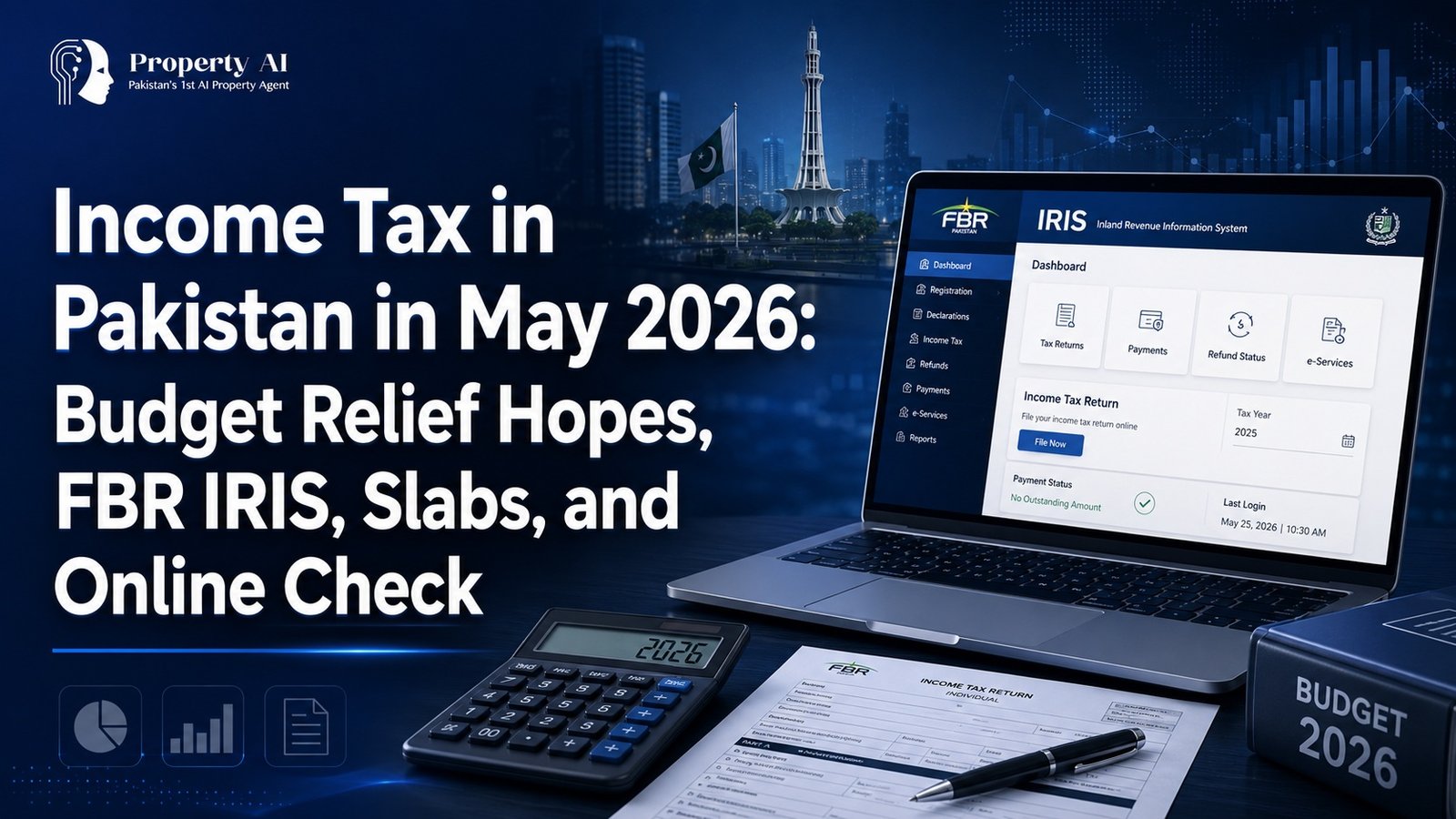
As of May 2026, Pakistan’s income-tax debate is moving in two directions at the same time. On one side, Dawn reported that the federal government is considering income-tax relief for salaried individuals while possibly keeping salaries and pensions unchanged in the coming budget. On the other side, Business Recorder reported that the Businessmen Panel (BMP) of FPCCI is resisting a reported plan for Rs230 billion in new taxes in the next budget. At the same time, Daily Times reported that FBR Chairman Rashid Mahmood Langrial told LCCI that, in its new role, the FBR would provide the business community with maximum facilitation.
For taxpayers, that means one thing: the budget discussion is still fluid, but the current legal and filing framework remains the one already in force under the Income Tax Ordinance, 2001, the Tax Year 2026 withholding rate card, and FBR’s digital system built around IRIS 2.0, ATL, Tax Asaan, and ePayment 2.0.
If you are comparing salary taxation, business-tax exposure, and property-related decisions together, the Property AI chatbot is a useful first filter, and the Property AI city pages help place those decisions in a broader Pakistan market context.
What is happening in May 2026
The official budget process is active, but the federal budget for FY2026–27 had not yet been presented as of the May 2026 reporting you shared. The Finance Division had already issued the Budget Call Circular for FY2026–27 on January 27, 2026, and the document says the government was gathering revised estimates, budget estimates, and related inputs for the annual federal budget. The same circular also notes that the provisional ceilings were prepared on the basis of spending levels and inflation assumptions and explicitly says they did not include any likely increase in pay to be announced at the time of budget.
That is why the current income-tax discussion should be read as a pre-budget policy fight, not as a settled budget outcome. Officially, the government was still in consultation mode. The Finance Ministry’s own May 2026 press-release archive shows stakeholder meetings on the budget, including a May 5, 2026 consultative meeting with the Insurance Association of Pakistan on Budget 2026–27, attended by the Director General, Tax Policy Office and Member (Inland Revenue Operations).
The three biggest current signals in the income-tax debate
1) Possible relief for salaried taxpayers
Dawn reported that the government is considering reducing the income-tax burden on salaried individuals while refraining from increasing salaries and pensions in the next budget. The same report says informed sources indicated that the finance minister wanted to lower tax rates and, if possible, raise the taxable-income threshold for salaried individuals. Dawn also reported that officials were discussing the idea that not raising salaries could create fiscal space for direct tax relief instead.
That matters because the same Dawn report says the salaried class reportedly paid more than Rs425 billion in taxes during the first three quarters of the fiscal year, which it described as more than double the real-estate sector’s contribution of around Rs200 billion and higher than the combined revenue from wholesalers, retailers, and exporters. That is one reason salaried-tax relief has become such a strong budget talking point.
2) Business resistance to reported new taxes
At the same time, the private sector is pushing in the opposite direction. Business Recorder reported on May 11, 2026 that the Businessmen Panel (BMP) of FPCCI sharply opposed a reported plan to impose Rs230 billion in new taxes under the upcoming IMF-linked federal budget. The report quoted BMP’s chairman and FPCCI president Mian Anjum Nisar as warning that businesses were already dealing with high energy costs, expensive financing, currency instability, and weak demand, and that additional tax pressure would deepen the problem.
So the tax debate in May 2026 is not just about whether relief will come. It is also about who will bear the revenue burden if the government still needs to raise more money.
3) FBR’s message of facilitation
A third signal is administrative tone. Daily Times reported that FBR Chairman Rashid Mahmood Langrial, while addressing LCCI, said that in its “new role” the FBR would facilitate the business community to the maximum. Even though that media report is not the same thing as a formal budget announcement, it matters because it shows the tax administration is publicly trying to present itself as more business-facing while budget pressure remains high.
What remains official right now under FBR income tax
Whatever happens in the upcoming budget, the current official framework still runs through the same core FBR structure.
Income Tax Ordinance, 2001
FBR’s official Income Tax Ordinance page currently lists the Income Tax Ordinance, 2001 amended up to 20.02.2026, which is the updated legal backbone for income-tax administration in Pakistan as of the latest official upload visible in May 2026.
Five heads of income
FBR’s Income Tax Basics page says income chargeable to tax is broadly divided into five heads:
- salary,
- income from property,
- income from business,
- capital gains,
- income from other sources.
That matters because when people search income tax Pakistan, they often think only of salary tax. In reality, the legal framework is wider and affects different taxpayer types in different ways.
Current FBR rate-card framework
FBR’s official Withholding Tax Rate Cards page shows that the current public rate card is the Tax Year 2026 card, updated up to 30-06-2025 as per the Finance Act 2025. That means the public rate-card baseline for current withholding treatment remains tied to the last enacted Finance Act until a new budget changes it.
Income tax check online: the official routes that matter
For users searching income tax check online, FBR income tax, or income tax IRIS, the real answer is not one single page. It is an ecosystem of official FBR tools.
| Need | Official route | Why it matters |
|---|---|---|
| Legal framework | Income Tax Ordinance page | Shows the updated statutory text |
| Filing returns | IRIS 2.0 | Main online return-filing portal |
| Checking filer status | Active Taxpayer List (ATL) | Confirms filer status and related tax-rate benefits |
| Simplified salary filing support | Tax Asaan | Useful for simplified salary-return workflows |
| Paying tax online | ePayment 2.0 inside IRIS | Generates PSID and issues CPR digitally |
| Understanding categories of taxable income | Income Tax Basics | Explains the heads of income and core concepts |
| Withholding rates / slabs reference | Tax Year 2026 rate card | Official public rate-card reference |
These are the practical official routes a taxpayer should rely on in May 2026.
Income tax Pakistan calculator and FBR income tax calculator: what is actually official
A lot of users search phrases like:
- income tax Pakistan calculator
- FBR income tax calculator
- income tax check online
- FBR income tax slabs
The practical issue is that the official FBR system does not currently present one simple public page branded as a universal all-purpose “income tax calculator” for every taxpayer category in the way people often imagine. What it does provide officially is:
- IRIS 2.0 for filing,
- Tax Asaan for simplified salary-return workflows,
- Withholding Tax Rate Cards for public rate guidance,
- Income Tax Basics for category structure,
- and ePayment 2.0 for online payment creation.
So, if someone searches FBR income tax calculator, the honest answer is that the official path is usually a combination of rate-card guidance plus IRIS / Tax Asaan workflow, rather than a single universal calculator page for every situation.
FBR income tax slabs: what taxpayers should understand
Another common search is FBR income tax slabs. The safest current reference is the official Withholding Tax Rate Card for Tax Year 2026, because that is the live public FBR rate-card page visible in May 2026. At the same time, taxpayers should remember that “slabs” can vary by:
- income head,
- taxpayer type,
- withholding context,
- filer or non-filer status,
- and transaction type.
That is why many people make mistakes when they apply a salary assumption to every other income-tax case. A salaried employee, a business owner, and a property seller do not all sit under the same practical tax calculation path.
Income tax IRIS and ATL: why they matter more than people think
IRIS 2.0
FBR’s official IRIS page says IRIS helps you file your FBR income tax return easily, including simplified forms, income and wealth statements, and e-filing functions. That makes IRIS the center of the practical filing system.
Active Taxpayer List (ATL)
FBR’s official ATL material shows that ATL remains central to taxpayer treatment. FBR also says being on ATL gives benefits such as lower rates of tax deduction at source, including lower withholding tax in several situations, and specifically notes lower tax rates on buying and selling of property. FBR also provides SMS-based ATL checking by CNIC or NTN.
That matters because many people focus only on filing and forget the wider compliance effect. In practice, filing status can change what tax rates apply to you in transactions.
What salaried taxpayers, business owners, and property-side users should do before budget
Salaried taxpayers
Do not assume relief has already been granted just because it is under discussion. The budget had not yet been announced as of the reporting reviewed here. For now, keep working from the current Tax Year 2026 official framework and watch the budget process closely.
Business owners
Do not read the budget discussion in only one direction. While business groups are resisting reported new taxes, the government is still under revenue pressure, and official budget preparation is still ongoing. That means uncertainty remains high until the actual budget is presented.
Property-side users
If your next decision involves buying, selling, or holding property, do not look at tax in isolation. A lower or higher tax burden only makes sense when placed beside the underlying property decision. That is where the Property AI chatbot and Property AI city pages become useful: they help you compare location, project type, and budget before tax treatment gets layered on top.
Final verdict
As of May 2026, Pakistan’s income-tax story is defined by a three-way tension:
- possible relief for salaried taxpayers,
- resistance from business groups to reported new taxation,
- and an official tax system that still runs through the Income Tax Ordinance, 2001, IRIS 2.0, ATL, Tax Asaan, ePayment 2.0, and the Tax Year 2026 rate-card framework.
The practical takeaway is simple: the budget debate is moving, but the current compliance framework is still official and active until the next budget changes it. So taxpayers should not file, pay, or plan on the basis of rumours alone.
FAQs
How can I do an income tax check online in Pakistan?
The main official routes are IRIS 2.0, the Active Taxpayer List (ATL), Tax Asaan, the Income Tax Ordinance page, and the Withholding Tax Rate Card.
What is the official law for FBR income tax in Pakistan?
The governing legal framework is the Income Tax Ordinance, 2001, and FBR’s official site currently lists an amended version updated up to 20.02.2026.
Is there an official FBR income tax calculator?
FBR’s public system is built more around IRIS, Tax Asaan, rate cards, and official guidance pages than one single universal calculator page for every taxpayer category.
What are FBR income tax slabs right now?
The current official public rate-card reference is the Withholding Tax Rate Card for Tax Year 2026, updated as per the Finance Act 2025.
Is income-tax relief already final for salaried people in May 2026?
No. Media reporting says the government is considering relief, but the budget had not yet been presented, so final decisions were still pending.
Disclaimer:
This blog is for general awareness and planning. Budget measures under discussion are not final until formally announced, and taxpayer outcomes can differ by income head, filing status, withholding context, and transaction type, so professional review is still necessary before filing or payment.