
Quick Answer
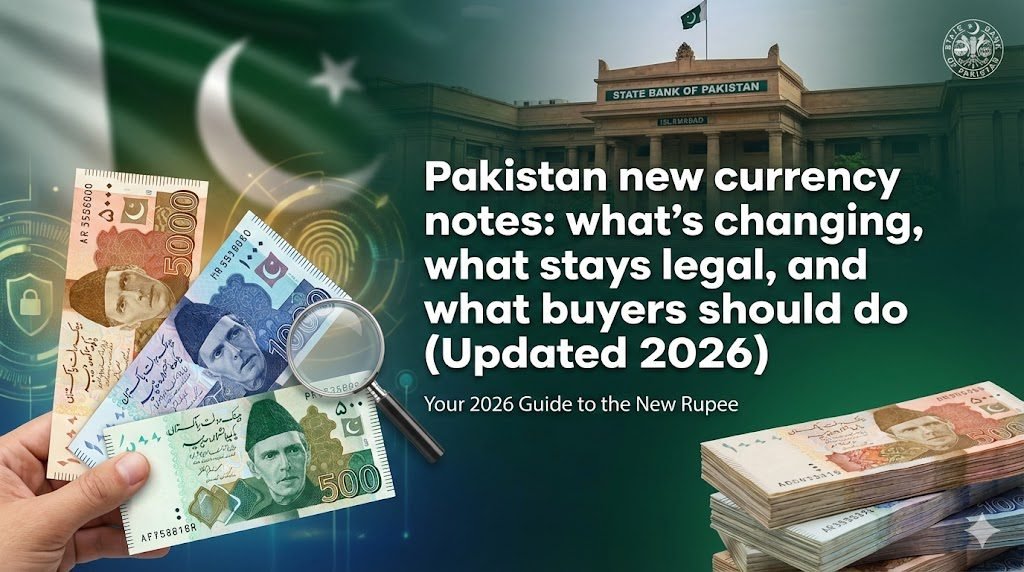
The Pakistan new currency notes project is real, but it’s not an overnight switch. The State Bank of Pakistan (SBP) has already started the formal process to design and issue a new banknote series for all existing denominations, and SBP has said final printable designs will go to the Federal Government for approval. SBP also stated that launching a new series typically takes 2–3 years, and the bank intended to complete the process within 2 years from its January 2024 start. SBP has also made it clear the existing notes will remain in circulation even after the new series is issued, and any withdrawal decision would be gradual and phased once new notes are available in sufficient quantity.
Official SBP reference: https://www.sbp.org.pk/press/2024/Pr-30-Jan-2024.pdf
If you’re worried you’ll wake up to “old notes banned,” this Quick Answer is the key: the transition is designed to be phased, not sudden.
Why people are confused right now
When the topic comes up in news and committee discussions, the public usually hears short lines like “new designs” and “enhanced security,” but not the operational reality:
- People assume “new notes” means old notes become invalid immediately
- Traders worry about cash handling machines, ATMs, note acceptors
- The public fears scams (“bring your cash to exchange today” type fraud)
- Social media clips blur the line between design stage and printing stage
So the right way to read the situation is: Pakistan new currency notes are in a structured pipeline, and the public-facing rollout will be staged.
What’s confirmed about Pakistan new currency notes (based on official SBP process)
From SBP’s official statement about initiating the new banknote series process:
- SBP started the process for a new banknote series of all existing denominations
- New series are introduced periodically to protect integrity and align with newer design and security technology
- SBP’s process includes design themes, professional banknote designers, and then submission to the Federal Government for approval
- Typical launch timelines are 2–3 years, with SBP aiming to complete within 2 years from early 2024
- The existing series remains in circulation even after issuance of the new series
- Any eventual withdrawal of old notes would be gradual and phased, once new notes are circulating sufficiently
This matters because it directly addresses the biggest public fear: a sudden overnight ban is not the designed pathway.
What “enhanced security features” usually means in modern banknotes
You’ll hear “enhanced security” a lot. Until SBP publishes exact feature lists for each denomination in the new series, nobody should claim a final feature set.
But globally, when central banks modernize banknotes, “enhanced security” commonly includes combinations of:
- Windowed security threads with clearer movement effects
- Color-shifting inks (ink changes color when tilted)
- Microtext that’s difficult to reproduce with standard printers
- Raised intaglio printing for touch-based checks
- More complex watermark structures
- UV features that are easier for banks/retailers to authenticate
- Better machine-readability for sorting and counterfeit detection
The important buyer takeaway is not memorizing the feature list today. The important takeaway is this: when the new notes start circulating, the public needs a simple verification habit and businesses need machine compatibility planning.
Table: What buyers should focus on at each stage
| Stage | What is happening | What buyers should do | What businesses should do |
|---|---|---|---|
| Design + approvals | Designs are finalized and sent for approval | Ignore “exchange your notes now” rumors | Start budgeting for cash-machine calibration |
| Printing + early distribution | Initial quantities enter circulation | Learn the basic authenticity checks SBP publishes | Update counterfeit detection training |
| Dual circulation (old + new) | Both series circulate together | Accept both, stay alert for fake “exchange fees” scams | Train staff to handle mixed-series cash |
| Gradual withdrawal (if announced) | Old series may be reduced over time | Follow SBP/bank notices, not WhatsApp forwards | Coordinate with banks for deposits and sorting |
Decision guide: should you do anything right now?
Most people don’t need to “do” anything immediately. Use this decision guide:
If you’re a normal salary earner or household buyer
- Keep using cash normally
- Don’t pay anyone to “convert” notes privately
- If you hold large cash at home, consider banking it for safety (this is general safety, not panic)
If you run a shop, petrol pump, pharmacy, or high-cash business
- Plan for a mixed-cash period where both old and new notes show up
- Make sure your staff can spot obvious counterfeits
- Be ready for machine updates (note acceptors, sorters, counting machines)
If you’re an overseas Pakistani bringing cash on visits
- Don’t panic-exchange based on rumors
- Use bank channels and licensed exchanges only
- Keep receipts for large exchanges as a normal compliance habit
Scam risk: the biggest real-world danger in “new currency” news
Whenever Pakistan new currency notes trend, scammers take advantage. The common fraud patterns are predictable:
- “SBP has banned old notes; pay a fee and exchange today”
- “Special window open for exchange; share CNIC and details”
- “We can convert your cash at home; give a commission”
- Fake “official” posters with random phone numbers and logos
Practical rule: If someone is asking you for money or personal data to ‘secure’ your cash, treat it as a scam. Real transitions are handled through banks and official channels.
What happens to old notes when new notes arrive?
People want a straight answer, so here it is based on the official process SBP described:
- Old notes are expected to remain in circulation even after the new series is issued
- If any withdrawal decision is taken later, it would be gradual and phased, and only once the new notes are circulating in sufficient quantity
So the realistic public experience is usually:
- You’ll see new notes slowly appear
- You’ll keep seeing old notes for a long time
- Banks and large cash handlers will gradually push old notes out through deposits and sorting
- Only after a long runway would any formal withdrawal steps (if ever) become relevant
Scenario examples (so this feels real, not theoretical)
Scenario 1: A retailer in Rawalpindi handles mixed cash daily
Your shop will see both old and new series together. The operational risk isn’t “old notes becoming illegal.” The risk is:
- staff accepting counterfeits during confusion
- arguments with customers who believe rumors
What helps: a simple staff instruction sheet once SBP publishes authenticity checks, and a policy to verify suspicious notes before giving change.
Scenario 2: A school collects fees in cash
Schools can face fake “exchange deadlines” rumors from parents. A good approach:
- keep accepting legal tender normally
- deposit cash more frequently during the transition period
- avoid holding large volumes in office safes longer than necessary
Scenario 3: A transport company uses cash counting machines
New notes often require calibration and software updates. The risk is not that machines “stop working,” but that they:
- reject valid notes
- miscount if settings are outdated
What helps: contacting your machine vendor early and budgeting for updates when the new notes are confirmed in the market.
Scenario 4: A family saving cash for a wedding
People saving in cash worry most. The practical approach is simple:
- if the amount is large, don’t keep it at home purely out of habit
- place it in a bank account and withdraw when needed
This reduces theft risk and also avoids stress if social media rumors spike again.
What SBP and the government still need to publish for full clarity
To remove public confusion, the market typically benefits from official publication of:
- A clear rollout timeline (even if broad)
- Visual spec sheets per denomination (front/back features)
- Simple “public authenticity checks” (look/feel/tilt)
- Guidance for banks and cash businesses (sorting, deposits, machine readiness)
- Clear statements about old note circulation status during transition
This is where buyers should anchor their expectations: the clarity comes from official releases and banking channels, not viral screenshots.
What this means for inflation and prices (a careful, practical note)
New currency notes do not automatically create inflation by themselves. Inflation is driven by broader monetary and fiscal conditions, supply constraints, and expectations. What new notes can affect in the short term is:
- counterfeit deterrence (positive if it reduces fake cash circulation)
- operational cost for businesses updating machines (small but real)
- public anxiety and rumor-driven behavior (avoidable with clear communication)
For most households, the impact is more psychological than economic—unless scams and counterfeits rise during confusion.
FAQs (high-intent)
1) When will Pakistan new currency notes be issued?
SBP has stated that launching a new banknote series generally takes 2–3 years, and it intended to complete the process within 2 years from the January 2024 initiation. Actual issuance depends on completion of design, approvals, printing, and distribution.
2) Will old notes become invalid immediately after Pakistan new currency notes launch?
Based on SBP’s official process statement, the existing banknote series is expected to remain in circulation even after the new series is issued, and any withdrawal decision would be gradual and phased once new notes circulate sufficiently.
3) Do I need to exchange my cash right now because of Pakistan new currency notes?
There is no practical reason for the public to exchange cash “right now” based only on rumors. Any real transition steps would be handled through official channels and banks, not private agents collecting fees.
4) What should businesses do to prepare for Pakistan new currency notes?
Businesses that rely on cash machines should plan for calibration/updates and train staff for mixed-series handling. The biggest immediate risk is confusion-driven counterfeit acceptance, not overnight invalidation.
5) How do I verify Pakistan new currency notes are genuine once they arrive?
Use SBP-issued public verification guidance once released (look/feel/tilt checks, watermark/thread/UV elements). Until SBP publishes the final feature set, treat any “feature list” circulating online as unverified.
Disclaimer
This article is general information based on publicly available official process statements and practical consumer guidance. For final timelines, designs, and verification methods, rely on SBP/government announcements and your bank’s official communication.