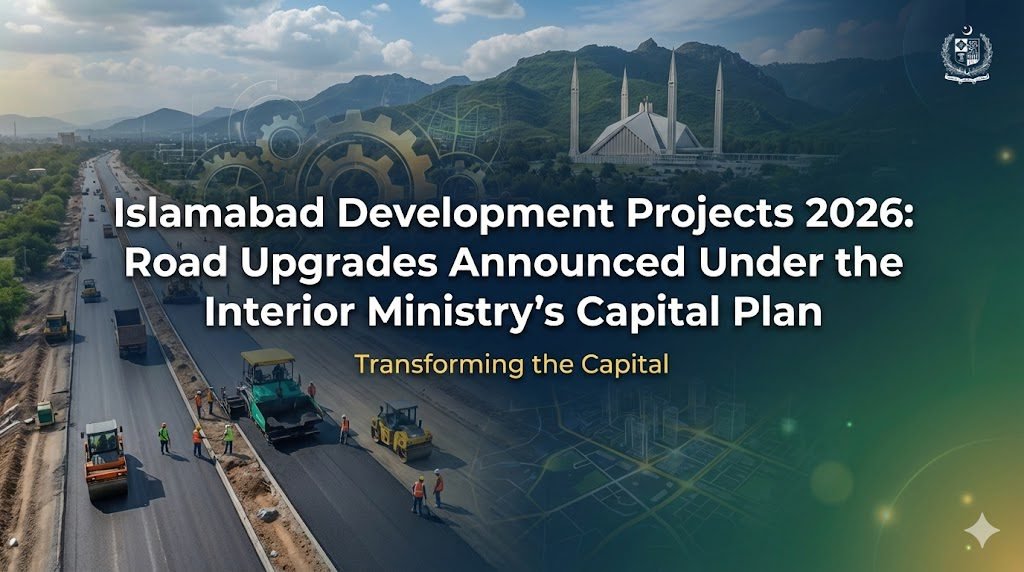
Islamabad development projects 2026 have become a practical conversation for every commuter, business owner, and buyer watching the twin cities’ daily traffic pressure. The capital’s growth is no longer limited to new sectors and private schemes; it is increasingly shaped by public infrastructure that changes travel time, access, and the “liveability” of entire corridors. When a major underpass opens or a signal-free route is planned, it affects how quickly people move between workplaces, schools, hospitals, and commercial zones and that directly influences property demand in Islamabad and linked pockets of Rawalpindi.
This article focuses on the development pipeline that has been publicly confirmed by Islamabad’s civic authorities and official government communications, with specific attention to mobility and traffic-flow projects that were discussed and advanced under the capital’s administrative setup.
Why Islamabad’s 2026 development pipeline is centered on mobility
Islamabad’s population and vehicle volume have grown faster than its original road network was designed to handle. The biggest stress points are the places where long-distance flow meets local movement: intersections close to education clusters, high-footfall commercial pockets, and routes used for daily commuting from Rawalpindi into Islamabad.
In practical terms, a road project matters when it reduces three pain points at the same time:
- Stop-and-go congestion at key junctions
- Delays that disrupt school and office timing
- Fuel waste caused by idling traffic
That is why underpasses, grade separation, and signal-free movement keep appearing in Islamabad’s recent development announcements. These are not cosmetic upgrades; they are targeted fixes for bottlenecks that impact thousands of vehicles daily.
Who manages development in Islamabad and why approvals still matter
Islamabad’s development environment has two tracks that people often mix up:
- Public infrastructure by the city’s civic authority
This includes roads, underpasses, interchanges, service roads, landscaping, and related urban works. - Private real estate projects that still need regulatory clearance
Even when a private developer markets a project in the Islamabad region, approvals and compliance remain the core due diligence step. Depending on jurisdiction, the relevant authority can include CDA for Islamabad, and RDA for many Rawalpindi-side developments.
For buyers and investors, this distinction matters because public works can increase accessibility and value, but it does not replace the need to verify approvals for any private society, apartment project, or commercial development.
Shaheen Chowk Underpass: what is confirmed and what it is meant to solve
One of the clearest, officially documented mobility projects leading into 2026 is the Shaheen Chowk Underpass, reviewed by CDA leadership as it neared completion in late 2025. In CDA’s official update dated Dec 28, 2025, the authority stated the project had moved into its final stage with more than 95% of development work completed, structural work completed, and finishing work progressing rapidly. The update also confirms active landscaping/horticulture and installation of permanent lighting aimed at improving both function and overall urban presentation. Capital Development Authority
The same CDA update frames the project’s practical benefit in commuter terms: signal-free movement for daily users (including adjacent institutions’ traffic), reduced pressure on the road network, and measurable savings in time and fuel for citizens. Capital Development Authority
What changes when a junction becomes signal-free
When a junction shifts from signal-based crossing to grade separation (underpass/flyover), the immediate changes are:
- Peak-hour flow becomes more predictable
- Emergency and service travel becomes faster
- Commercial access improves because “time cost” drops for visitors and deliveries
- Nearby residential demand can rise if commuting time improves without creating new noise/traffic issues inside streets
This is why Islamabad’s mobility projects often have a property market effect even though they are not “real estate projects” themselves.
Underpasses at Serena Chowk and Srinagar Highway: projects publicly announced for smoother flow
A separate official communication from the Government of Pakistan’s press information channel (dated May 21, 2024) states that two underpasses were announced for Islamabad traffic improvement: one at Serena Chowk and another at Srinagar Highway. The same official update references the objective of easing traffic movement through grade separation and improving flow on key routes. PID
In that official communication, the government also references a signal-free corridor plan for Srinagar Highway, reflecting a broader mobility approach rather than isolated construction. PID
Why Serena Chowk and Srinagar Highway matter in daily movement
Even without overcomplicating the map, these names matter because they sit near high-activity zones. When traffic at such points becomes smoother, the effect spreads outward: secondary roads carry less spillover congestion, and commuters experience fewer “dead stops” that disrupt timing for schools, offices, and appointments.
What a “signal-free corridor” actually means for residents and investors
In Islamabad, “signal-free” is often used casually, but it generally refers to removing repeated signal stops along a key stretch by using grade separation at major junctions, improving merges, and managing entry/exit movement.
For residents, the benefit is straightforward: fewer unpredictable delays. For investors and businesses, the benefit shows up in three ways:
- Footfall reliability: customers can reach commercial areas more consistently
- Delivery and service efficiency: logistics becomes less time-expensive
- Rental demand stability: tenants often prefer areas with easier daily access to workplaces and education zones
This is also the point where Islamabad and Rawalpindi connect in real market behavior: when commuting becomes easier, demand can shift across the twin cities depending on pricing and lifestyle preferences.
What this means for property decisions in Islamabad and linked Rawalpindi corridors
Mobility upgrades do not automatically make every nearby plot or apartment a “good investment.” They do, however, change the questions a serious buyer should ask in 2026:
1) Is value coming from access, or only from marketing?
If a location benefits from confirmed public infrastructure, it has a stronger base than a location relying purely on promises.
2) Are you buying near a bottleneck that is being fixed, or near a bottleneck that is shifting?
Sometimes traffic “moves” from one junction to another. Buyers should observe where queues form after a project becomes operational.
3) Is the private project verified on approvals and deliverability?
Public infrastructure can raise area interest, but a private scheme still needs proper legal standing and compliance. Islamabad buyers should stay disciplined about checking the relevant authority’s status for the exact project category and jurisdiction.
Development due diligence checklist that still applies in 2026
If you are assessing a private project that claims proximity to Islamabad’s new road upgrades, keep the due diligence practical:
- Approval status: verify the correct authority for that project’s jurisdiction (Islamabad vs Rawalpindi side)
- On-ground progress: visit at different times (weekday, weekend) to see actual development activity, not only a site office
- Utilities planning: ask for clarity on water, sewage, and power arrangements, not just plot demarcation
- Possession record: check whether earlier phases (if any) were delivered on time
- Access realism: measure time from main roads during peak hours, not during quiet hours
Where Property AI fits in this process (without replacing verification)
For buyers comparing verified options across Islamabad and Rawalpindi, it helps to keep the search structured rather than scrolling random listings. Using Property AI Cities, you can narrow listings by city context and filter your shortlist before you do site visits and approval checks.
If you want a quick shortlist based on your budget, purpose (end-use vs investment), and preferred routes, you can also use the Property AI Bot to organize options and questions for developers or dealers before you commit time to meetings.
FAQs
1) What are the Islamabad development projects 2026 focused on traffic improvement?
Islamabad development projects 2026 include mobility upgrades such as underpasses and signal-free movement plans. Official updates reference the Shaheen Chowk Underpass nearing completion in late 2025 and earlier announcements of underpasses at Serena Chowk and on Srinagar Highway. Capital Development Authority+1
2) Is the Shaheen Chowk Underpass officially confirmed as a CDA project?
Yes. CDA’s official update dated Dec 28, 2025 confirms the Shaheen Chowk Underpass project status, including completion percentage and finishing works such as landscaping and permanent lighting. Capital Development Authority
3) Were underpasses at Serena Chowk and Srinagar Highway officially announced?
Yes. An official government press information update dated May 21, 2024 references two underpasses for Serena Chowk and Srinagar Highway, along with a signal-free corridor plan for Srinagar Highway. PID
4) Do Islamabad road projects affect property prices in Rawalpindi too?
They can, especially when commuting time between the twin cities improves. Better travel reliability can shift rental demand and buyer preference across connected corridors, but each private project still needs separate verification of approvals and deliverability.
5) What is one practical step before buying near a “signal-free corridor” claim?
Do a peak-hour drive test and compare weekday vs weekend conditions. Then verify whether the private project’s approval status matches the correct authority for its jurisdiction, instead of relying on marketing language.
Disclaimer: Information is for awareness, subject to change, and buyers should verify approvals and details independently.