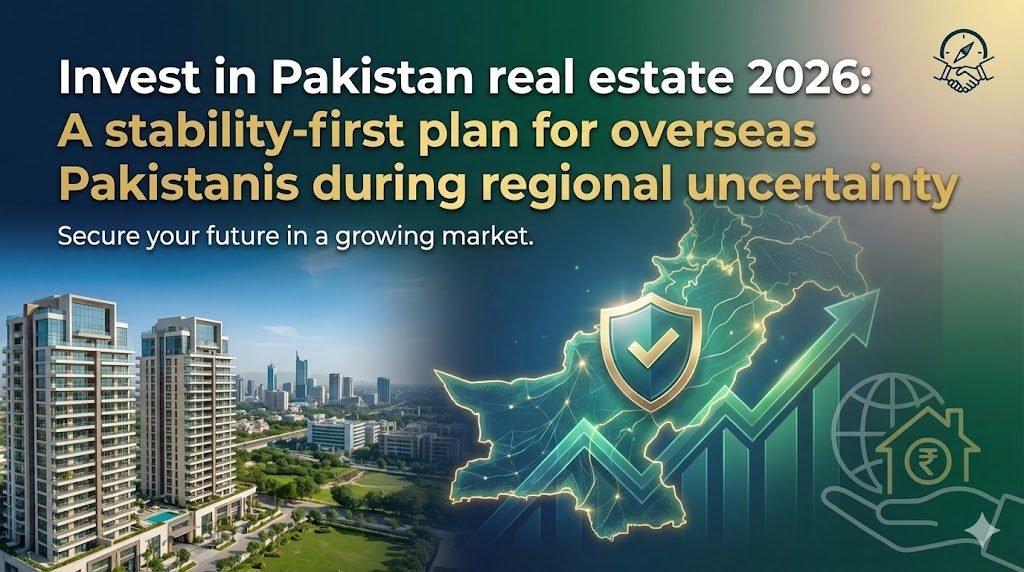
When headlines turn into travel disruptions and regional uncertainty, overseas Pakistanis start asking a practical question: where should long-term family wealth sit right now? For many, invest in Pakistan real estate 2026 has become a serious search intent—not because of hype, but because real estate at home can offer something people value most in tense cycles: control. Control over the asset, the paperwork, the tenant, and the exit plan.
This blog is written for overseas Pakistanis and families in Pakistan who are thinking about shifting or balancing investment away from uncertainty in the Gulf region and into home-market assets—especially in Islamabad and Rawalpindi, where verified demand, livability, and resale depth often remain stronger than many speculative zones. It keeps the tone professional and market-aware, focusing on due diligence, approvals, liquidity, and realistic planning.
What changes in 2026 when regional tension rises
In uncertain cycles, investors stop chasing “best returns” and start prioritizing three outcomes:
1) Predictable access to your money and movement
When travel patterns and air corridors face disruption, even routine logistics can become stressful. This is one reason people start valuing home-market assets: the asset is in the country where your family and your legal standing are strongest.
Pakistan’s aviation regulator and airport authority have publicly addressed recent questions about operational continuity and routing availability through official communications, reinforcing that civil aviation operations can continue through Pakistan’s airspace even when surrounding routes face restrictions. This matters because perception of connectivity affects business confidence and diaspora decision-making. You can review the official statement on the Pakistan Airports Authority website.
2) A hedge that does not depend on daily market sentiment
Real estate is not as liquid as cash, but it is also not as emotionally reactive as many short-term markets. For families who want wealth preservation and a stable base, property often becomes the “anchor” asset.
3) A shift from speculation to safety-first investing
In a calm bull market, people tolerate weak paperwork and “future promises.” In a tense market, that tolerance collapses. Buyers prefer assets that are possession-ready, properly documented, and easy to explain to a bank, a lawyer, or an heir.
Why “invest in Pakistan real estate 2026” is trending for overseas Pakistanis
This topic is rising because overseas Pakistanis often hold wealth in a mix of:
- cash savings abroad,
- assets in Gulf markets,
- and family commitments back home.
When uncertainty increases, the instinct is not always to exit everything. Often it’s to rebalance: shift a portion into Pakistan where the investor has stronger family support, stronger cultural familiarity, and easier long-term control of property management.
For many overseas Pakistanis, investing in Pakistan is also a legacy decision: a secure home base, a future retirement option, or a property that supports family housing plans.
Pakistan is not one market: Islamabad and Rawalpindi behave differently than “general Pakistan”
If you are making a stability-first decision, you should avoid thinking in slogans like “Pakistan is cheap” or “Pakistan is safe.” Real markets are specific. The better question is:
Which city has the strongest combination of:
- verified demand,
- legal clarity,
- infrastructure,
- and resale depth?
For many diaspora investors, the answer often narrows toward Islamabad and Rawalpindi, because:
Islamabad: scarcity, structure, and end-user pull
Islamabad’s strongest advantage is that many neighborhoods have predictable planning, consistent end-user demand, and a buyer base that prioritizes livability. In uncertain cycles, buyers tend to prefer locations that remain desirable even when investor sentiment softens.
Rawalpindi: larger buyer base and broader affordability bands
Rawalpindi often offers:
- a larger spread of budgets,
- stronger rental demand in practical living zones,
- and a market where mid-range assets can still see steady absorption.
Islamabad and Rawalpindi also benefit from being a combined economic zone where people live in one city and work in the other, which strengthens rental consistency when the right location is chosen.
The “safety-first” real estate strategy for 2026
A safety-first approach is not “buy anything because it’s home.” It is a structured method designed to reduce regret.
Step 1: Choose the purpose first
Before you choose a society or a sector, decide what the asset is meant to do.
- Family use within 12–36 months: prioritize livability and possession certainty.
- Rental income support: prioritize tenant demand zones and utility readiness.
- Long-hold wealth preservation: prioritize approvals, infrastructure, and resale depth.
- Future retirement base: prioritize comfort, access, healthcare proximity, and maintenance standards.
If you don’t choose the purpose first, you end up buying what is popular instead of what is suitable.
Step 2: Select “certainty type” assets, not “promise type” assets
In 2026, safety-first investors usually choose:
- possession-ready or near-possession assets,
- documented transfer routes,
- communities with proven on-ground infrastructure.
Promise-type assets (pure files, future phases with unclear timelines, unverified approvals) can still be profitable in some cases, but they are not the safe option when your goal is capital protection.
Step 3: Split your investment into a “core + satellite” plan
A professional approach for overseas Pakistanis often looks like this:
- Core (70–80%) in certainty assets (clear documentation, stronger resale, easier rent)
- Satellite (20–30%) in controlled upside assets (only after you verify approvals and execution discipline)
This prevents one mistake from consuming your entire budget.
What overseas Pakistanis should buy in Islamabad and Rawalpindi in 2026
This section avoids naming specific private projects because the safe approach depends on verified approvals and real-time status. Instead, it focuses on asset types and what usually works best.
1) A livable apartment in a high-demand pocket
Apartments often give diaspora investors:
- easier management,
- more predictable rental behavior,
- and less maintenance burden than houses.
A good apartment investment is not decided by the lobby photo. It’s decided by:
- building management quality,
- utility stability,
- legal documentation,
- and consistent tenant demand.
2) A portion-friendly home with separate access
For investors thinking about rental income plus family flexibility, a home that can operate as two independent living portions is often a strong safety-first asset.
What matters:
- separate entry or at least independent staircase flow,
- utility management,
- parking practicality,
- neighborhood acceptance of portion rentals.
3) A plot only when the legal and execution proof is strong
Plots can work as long-hold capital storage, but they require stronger verification because:
- “file vs plot” confusion is common,
- possession and development claims are frequently overstated,
- and resale liquidity depends heavily on approval clarity.
In a safety-first cycle, buying a plot with unclear status is not a smart “homeland investment.” It’s a risk position.
High-intent checklist: what to verify before you invest in Pakistan real estate 2026
Overseas Pakistanis often lose money not because the market is bad, but because verification was weak. Use this checklist to protect yourself.
Legal and approval verification
- Which authority governs the scheme or area?
- Is the approval status verifiable from the authority’s official channel?
- Is the property transferable through a known, documented process?
On-ground reality
- Are roads, utilities, and development visible where your asset is located?
- Is there real occupancy nearby, or only signage?
Documentation and ownership chain
- Is the seller the rightful owner with a clear transfer path?
- Are there outstanding dues or restrictions?
Payment safety
- Use traceable payments and keep formal receipts.
- Avoid informal cash chains, especially when you are abroad.
Exit plan
- If you needed to sell within 90–180 days, how realistic is it?
- Is there a buyer base for your exact asset type?
A safe investment is one where you can explain the asset clearly to a cautious buyer.
Why the Gulf uncertainty factor pushes “home market” investing
People living in or connected to Gulf economies often make decisions based on:
- job stability,
- residency rules,
- business continuity,
- travel logistics,
- and family risk management.
In uncertain cycles, investors often want at least one strong anchor asset where:
- ownership rights are culturally and legally familiar,
- family support exists for management,
- and long-term residency is not a question mark.
Pakistan is the natural anchor market for overseas Pakistanis, but only when the investment is done with discipline.
The oil and “safe passage” narrative: how to treat it responsibly
You mentioned oil, safe passage, and global airlines as reasons to position Pakistan positively. These themes can be part of an optimism narrative, but a professional investor blog should keep them grounded:
- Energy exploration and resource news can support long-term economic confidence, but it should not be used as a direct guarantee that property prices will rise.
- Aviation routing and connectivity confidence supports business sentiment, but property decisions still depend on approvals, infrastructure, and end-user demand.
In short: use macro signals as context, not as proof of return.
The correct way to encourage overseas Pakistanis without exaggeration
Overseas Pakistanis respond better to clarity than slogans. A strong message is:
- Pakistan can be a practical place to build and preserve family wealth,
- Islamabad and Rawalpindi often offer stronger resale depth for safety-first buyers,
- and disciplined verification is the difference between a stable asset and a future dispute.
This tone builds trust without making absolute claims about any country.
Where Property AI fits (neutral, limited, and practical)
For diaspora investors comparing options remotely, the hardest part is filtering noise. One property sounds perfect in a voice note, the next looks better in a picture, and none of it is structured.
For buyers comparing verified inventory across Islamabad and Rawalpindi, Property AI can help organize shortlisting using location context and listing structure. It does not replace official verification, but it can reduce confusion when you are evaluating multiple options from abroad.
Conclusion: a disciplined “invest in Pakistan real estate 2026” plan beats emotional decisions
If regional uncertainty is pushing you toward homeland investing, the winning approach is not emotional. It is structured:
- choose purpose first,
- invest in certainty assets first,
- verify approvals and transfer route,
- and keep an exit plan.
For many overseas Pakistanis, Pakistan can be a strong anchor market because it aligns legal familiarity, family presence, and long-term lifestyle options. Islamabad and Rawalpindi often remain the most stable starting point because their buyer base and end-user demand are stronger than pure speculative zones.
FAQs
Is it a good time to invest in Pakistan real estate 2026 as an overseas Pakistani?
It can be, especially if your goal is stability and long-hold wealth preservation. The key is choosing documented, verifiable assets with proven demand, particularly in Islamabad and Rawalpindi.
Which city is safer for a stability-first property investment in Pakistan?
Safety-first in property usually means legal clarity, end-user demand, and resale depth. Islamabad and Rawalpindi often perform well on these factors when the asset is properly verified.
What should I avoid when I invest in Pakistan real estate 2026?
Avoid promise-only inventory with unclear approvals, unclear possession timelines, and unclear transfer routes. Also avoid informal payment chains that cannot be documented.
How can overseas Pakistanis reduce risk when buying property in Pakistan?
Use a strict verification checklist: authority status, documentation chain, on-ground development, and a clear exit plan. Keep payment traceable and documented.
Does regional travel disruption make Pakistan property more attractive?
It can influence sentiment and encourage diaspora investors to hold more assets at home, but property value is still determined by approvals, infrastructure delivery, and buyer demand in the specific area.
Disclaimer: Information is for awareness purposes only and is subject to change. Buyers should verify approvals and details independently.