
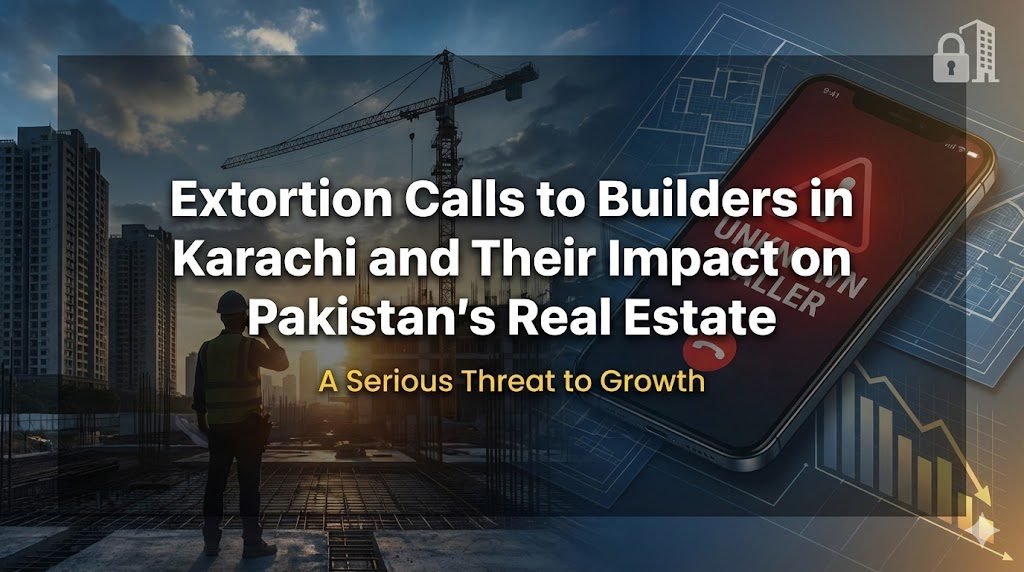
The recent extortion threats to builders in Karachi have pushed a sensitive security issue into the center of Pakistan’s real estate conversation. When leading members of the Association of Builders and Developers of Pakistan (ABAD) stand in front of cameras and warn that construction activity in Karachi may shut down from 15 January 2026, the concern is not limited to one city – it affects investor confidence across Pakistan.
This blog unpacks what is currently happening with builders and developers in Karachi, why extortion is such a serious risk for the real estate and construction sectors, and what buyers, investors, and professionals should keep in mind while evaluating projects – especially in major cities like Karachi, Islamabad, and Rawalpindi.
1. What is happening with builders and developers in Karachi?
According to media reports, ABAD’s leadership has publicly stated that:
- Multiple builders and developers in Karachi have received extortion calls from numbers traced to the UAE and Iran.
- Demands of around Rs 50 million have been made from some members.
- In certain cases where payments were not made, employees were reportedly shot and injured.
- ABAD has issued a one-month ultimatum to the government: if law-enforcement agencies fail to control extortion and kidnapping for ransom, construction activity in Karachi will be halted from 15 January 2026.
This is not an isolated incident but part of a pattern that Karachi’s business community has raised earlier as well. Builders, traders, and industrialists all depend on predictable security to keep projects running and workplaces safe.
For real estate, the stakes are even higher. Every under-construction project represents:
- Advance payments from buyers and investors
- Financing from banks and private lenders
- Commitments to contractors, labor, and suppliers
- Future housing and commercial inventory for the city
Any disruption caused by extortion threats to builders in Karachi directly touches all of these layers.
2. Who is ABAD and why does its warning matter?
The Association of Builders and Developers of Pakistan (ABAD) is a national-level representative body for private-sector builders and developers, established in 1972.
ABAD’s stated objectives include:
- Representing builders and developers at national level
- Coordinating with government on housing policy and regulations
- Raising issues faced by members in project execution
- Promoting organized, regulated development and construction
Because ABAD represents a significant portion of Pakistan’s formal builders and developers, its public position carries weight. When its leadership says that security conditions in Karachi have reached a point where it is considering a city-wide construction shutdown, several signals are sent to the market:
- Developers fear for staff safety, site security, and cash handling.
- Investors worry about project delays, liquidity, and completion risk.
- Banks and lenders become more cautious about financing high-risk environments.
- Overseas Pakistanis hesitate to channel remittances into projects that feel exposed to criminal networks.
For a city that remains one of Pakistan’s main engines for construction and housing demand, this kind of alarm from ABAD is serious.
3. How extortion threats damage Karachi’s construction and property market
3.1 Project timelines and costs
When developers face extortion threats in Karachi, they are forced to divert attention and resources from construction toward security and crisis management. That can lead to:
- Slower pace of work at sites
- Higher security costs for projects, offices, and staff movements
- Disruptions in material deliveries if transporters feel unsafe
- Interruptions in cash flows when developers hesitate to move money in visible ways
Every delay adds cost. Contractors and labor often bill for idle time. Rental of machinery, scaffolding, and formwork keeps ticking even when work slows down. In the end, these costs either eat into the developer’s margin or are passed on to buyers through higher prices or delayed possession.
3.2 Investor confidence and off-plan sales
Off-plan buying – where apartments, shops, or offices are sold before completion – depends heavily on trust. Buyers rely on several assumptions:
- The project will remain legally secure.
- Construction will progress roughly on schedule.
- The developer can operate freely without intimidation.
When extortion threats to builders in Karachi surface in the news, that trust weakens. Some investors pause payment plans. Others shift capital toward Islamabad and Rawalpindi, where the conversation is more about approvals, infrastructure, and planning rather than personal safety.
For Karachi developers, that means a risk of:
- Slower cash inflows from installments
- Difficulty launching new towers or phases
- More dependence on a smaller pool of buyers willing to tolerate risk
3.3 Employment, allied industries, and the wider economy
ABAD representatives have highlighted that the climate of extortion and insecurity has already pushed some businesses to move out of Karachi, impacting the city’s share in national tax contribution.
Construction is deeply connected with other sectors:
- Cement, steel, tiles, sanitary ware, and paints
- Transport and logistics
- Architecture, engineering, and urban planning
- Daily wage labor and skilled trades
If contractors and builders reduce activity due to extortion threats, it affects thousands of families whose livelihoods depend on daily work at sites and in supply chains.
4. Legal and security framework around extortion
Extortion and kidnapping for ransom are serious criminal offenses under Pakistan’s penal and anti-terrorism laws. Law-enforcement agencies and specialized units, such as the Sindh Police’s counter-terrorism and anti-extortion divisions, are empowered to register FIRs, trace calls, and coordinate with national and international agencies when overseas numbers are used.
However, the current debate is not about whether laws exist; it is about implementation speed and the level of protection businesses feel on the ground. Builders and developers are asking for:
- Faster tracing of overseas numbers used for threats
- Red warrants and international cooperation where required
- Visible action against named individuals and gangs
- Practical protection for sites, staff, and offices in high-risk zones
When enforcement looks slow, criminal groups feel encouraged to target high-value individuals, including real estate sponsors who handle large transactions and deal with multiple stakeholders.
5. What this means for buyers and investors in Karachi
For everyday buyers and investors, extortion threats to builders in Karachi raise several practical questions:
- Will my project face delays if the sponsor is under threat?
- Can the developer maintain site operations safely?
- Is it better to diversify into Islamabad, Rawalpindi, and other cities for the next few years?
There is no one-size-fits-all answer, but some patterns are clear:
- Reputation matters more than ever
Developers with longstanding track records, completed projects, and visible associations with industry bodies like ABAD generally have stronger networks and more structured responses when security challenges arise. - On-ground progress reduces anxiety
Projects that have already topped out, reached grey-structure completion, or are in finishing stages carry different risk compared to soft-launch or pre-launch schemes. - Diversification across cities can reduce exposure
For investors heavily concentrated in Karachi, allocating part of the portfolio toward Islamabad and Rawalpindi – where regulatory focus today is more centered on approvals, NOCs, and land use enforcement – can spread risk across markets. - Due diligence is not optional
In a higher-risk security environment, blind trust in marketing campaigns or verbal assurances becomes dangerous. Buyers need verifiable information.
6. Role of transparent data platforms in this environment
When risks rise, verified information becomes even more important than in a normal market cycle. This is where technology-driven platforms enter the picture.
AI-enabled real estate tools can:
- Aggregate publicly available information on approvals, NOCs, and regulatory notices
- Structure data about developer reputation and past delivery performance
- Help users compare multiple projects in Karachi, Islamabad, and Rawalpindi on objective parameters instead of only marketing material
Platforms like Property AI position themselves as AI-driven property assistants that focus on verified listings, on-ground development data, and transparent comparisons across projects and cities. Used properly, such platforms give buyers and investors a clearer view of:
- Who the developer is
- What stage the project is actually at
- Which approvals and documents are on record
- Whether there are public notices or regulatory flags associated with related entities
Technology cannot replace security and law-enforcement action, but it helps users make more informed decisions within the available environment.
If a buyer wants help understanding the risk profile of a Karachi project compared with options in Islamabad or Rawalpindi, they can even interact with the Property AI assistant bot for data-driven guidance based on current listings and verified information.
7. Key points for builders and developers
For builders and developers operating in Karachi under these conditions, several priorities stand out:
- Documentation and reporting
- Promptly report extortion calls and threats to relevant law-enforcement units.
- Maintain written records of complaints and FIRs.
- Staff safety protocols
- Review travel patterns for key staff involved in cash handling or site supervision.
- Coordinate with local police stations for patrolling around sensitive project sites.
- Transparent communication with clients
- Avoid panic, but share realistic timelines and construction status updates with buyers.
- Use digital platforms and periodic site photos or videos to maintain confidence.
- Collective action through associations
- Work through ABAD and sector committees so that individual builders are not isolated.
These points do not remove the risk, but they support a more resilient and coordinated response.
8. Practical checkpoints for property buyers in Karachi
Buyers and investors assessing under-construction projects in Karachi can keep the following checkpoints in mind:
- Membership and reputation
- Ask whether the developer is a member of a recognized body such as ABAD.
- Review completed projects, especially delivery timelines and build quality.
- Approval status
- Request written proof of layout approval and relevant NOCs from the Sindh Building Control Authority (SBCA) or other competent authorities where applicable.
- Construction stage
- Visit the site or review recent verified visuals.
- Compare promised schedule with actual progress.
- Contract and payment structure
- Favour structured payment plans tied to construction milestones over large upfront lump-sum payments.
- Keep all receipts and formal agreements safely documented.
- Portfolio balance
- Consider spreading investment across more than one project and, where relevant, across cities such as Islamabad and Rawalpindi, especially for long-term holdings.
- Information sources
- Use transparent digital tools, including AI platforms like Property AI, to cross-check project information rather than relying only on sales pitches.
None of these points replace legal advice, but they help buyers behave more like informed participants in a complex market.
9. Outlook for Karachi’s construction sector
The ultimatum from ABAD – shutting down construction in Karachi if extortion is not controlled – is a strong pressure signal directed toward the federal and provincial governments, law-enforcement agencies, and the security apparatus.
The likely outcomes depend on how quickly:
- Law-enforcement agencies move against identified groups and individuals
- International cooperation is mobilized for suspects operating from abroad
- The state reassures builders, investors, and workers that Karachi remains a viable place to build and do business
For now, one thing is clear: extortion threats to builders in Karachi are not just a policing issue; they are a direct threat to housing supply, job creation, urban renewal, and the wider economic contribution of Pakistan’s largest city.
For buyers and investors, the most sensible approach is disciplined risk assessment, careful project selection, and reliance on verified data rather than unchecked optimism.
At the same time, technology-driven platforms such as Property AI can support users with structured information, verified listings, and city-to-city comparisons across Karachi, Islamabad, Rawalpindi, and other major markets – enabling better decisions even in a challenging environment. To go deeper into project-level details, you can also talk to the Property AI assistant bot for data-guided property analysis tailored to your requirements.
FAQs on extortion threats to builders in Karachi
1. What are extortion threats to builders in Karachi?
Extortion threats to builders in Karachi refer to phone calls, messages, or in-person demands where criminals pressure developers and contractors to pay money, often in large amounts, by threatening violence, kidnapping, or disruption of work at construction sites. Recent reports mention calls from overseas numbers, including locations such as the UAE and Iran, demanding high sums from members of ABAD.
2. How are extortion threats to builders in Karachi affecting property buyers?
When developers face extortion threats, project timelines and cash flows can be disturbed. That can lead to construction delays, higher project costs, or in extreme situations, work stoppages. Buyers and investors may experience slower possession, increased anxiety about project completion, and greater dependence on the developer’s ability to manage security and legal follow-up.
3. Do extortion threats to builders in Karachi change real estate prices?
Pricing outcomes vary by location and project type, but several trends are possible. Some projects may offer relatively softer payment terms to keep sales moving despite negative sentiment. At the same time, safer and better-regulated areas can become more attractive, which may support stronger prices there. Overall, sustained extortion threats to builders in Karachi can reduce appetite for high-risk projects and shift demand toward well-regulated zones and other cities such as Islamabad and Rawalpindi.
4. What should investors ask a developer in Karachi before booking?
Investors can ask about:
- The developer’s track record and any completed projects
- Membership in recognized associations such as ABAD
- Approval and NOC status from relevant authorities
- Actual on-ground construction progress versus announced timelines
- Security arrangements at the site and in surrounding areas
These questions help investors understand both market risk and the developer’s ability to navigate challenging conditions.
5. Which authorities can builders contact when facing extortion in Karachi?
Builders and developers who receive extortion threats in Karachi can approach local police stations, specialized anti-extortion or counter-terrorism units, and relevant provincial authorities. Industry bodies such as ABAD also provide complaint support channels and coordinate member concerns with government agencies through formal representations and meetings.
Disclaimer:
All information in this blog is provided for general awareness and is based on publicly available sources at the time of writing. Regulations, security conditions, and market dynamics may change without notice. Buyers and investors should independently verify approvals, legal status, and on-ground conditions of any project before making financial commitments.