
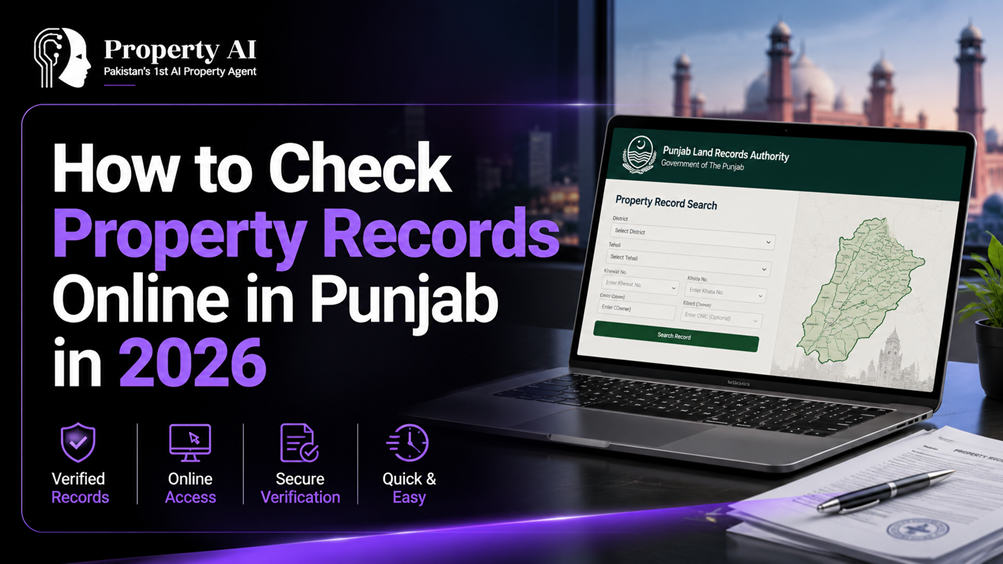
To check property record online Punjab buyers should begin with the official Punjab Land Records Authority system. Use the Punjab Zameen portal or mobile app to review computerized ownership information, request a Fard and monitor mutation-related records. Use the Registration of Deeds portal for an available old e-registry and the e-Registration portal for a newer registered deed.
That is only the first part of verification.
A buyer considering property in a private housing society must also check the project’s current status and approved layout through the relevant development authority. For example, use RDA for Rawalpindi, LDA for Lahore and the appropriate local authority for other Punjab cities. Islamabad falls under CDA and Islamabad Capital Territory procedures, not the Punjab land-record system.
“An online ownership record, an approved housing scheme and a physically identifiable plot are three separate checks.”
What Can You Check Online in Punjab in 2026?
Punjab’s digital property system now provides several different services. Each service answers a different question.
| Official record or service | What it can help confirm | What it does not prove by itself |
|---|---|---|
| Online Fard | Names and shares recorded in the computerized revenue record | Housing-scheme approval, possession or freedom from every legal dispute |
| Registered deed or e-registry | The document through which sale, gift, exchange or another transaction was registered | That mutation has been completed or the seller has physical possession |
| Mutation or Intiqal record | Whether a transfer has been entered and attested in the revenue record | That the construction, scheme or land use is approved |
| Green Property Certificate | Digitally supported ownership and property-status verification through the new PLRA process | A replacement for every authority, society and legal check |
| PULSE parcel map | Available geographic or parcel information linked with digitized land records | Final boundary demarcation in every location |
| Development-authority portal | Housing-scheme status, layout approval, NOC or illegal-scheme information | Individual ownership of the specific plot |
| Housing-society ledger | Allotment, payments, transfer history and society-side ownership | Revenue ownership or authority approval unless independently confirmed |
The Punjab Land Records Authority states that its Arazi Record Centres provide services including Fard issuance, ownership verification, property transfer and registration. Its Punjab Zameen app also supports ownership verification, Fard applications and mutation tracking.
What Information Should You Collect Before Searching?
An online property search becomes easier when the seller provides complete information.
Ask for:
- seller’s full name and CNIC or NICOP;
- district and tehsil;
- mouza or revenue-estate name;
- Khewat number;
- Khatooni number;
- Khasra number;
- property size and ownership share;
- registry number and registration year;
- mutation or Intiqal number;
- housing-society name, phase, block and plot number;
- allotment or transfer letter;
- latest payment ledger;
- approved map or layout-plan reference.
Do not accept “everything is online” as an answer. Ask the seller to identify exactly which record, authority and parcel the claim refers to.
How to Check Property Record Online Punjab Step by Step
Step 1: Start with the official Punjab Zameen system
Open the official Punjab Land Records Authority portal rather than a link sent through WhatsApp, Facebook or an unknown property website.
The official platform provides access to land-record services, Arazi Record Centre information, registry services, mutation guidance, the Punjab Zameen app and the Green Property Certificate process.
Check the web address carefully. Fraudulent pages may copy government colours, logos or Urdu wording.
Step 2: Request or verify the Online Fard
Use the official Online Fard system to begin the computerized land-record check.
The system may require identity verification and property-location information. The available search and application fields can depend on the record, district and digitization status.
When reviewing the Fard, match:
- owner’s name;
- father’s or husband’s name where shown;
- CNIC details where available;
- ownership share;
- Khewat, Khatooni and Khasra references;
- total land area;
- the seller’s claimed portion;
- date of issuance;
- verification or reference details.
PLRA states that Fard can be obtained through its official digital portal and through Arazi Record Centres or approved service points.
“A recently issued Fard is more useful than an old photocopy, but it should still be matched with the deed, mutation and physical property.”
Step 3: Check the registered deed
A Fard shows the revenue record. A registered deed shows the document through which a transaction was formally registered.
Punjab currently operates separate digital routes for:
- new property registration through the e-Registration system;
- historical deed access through the Record of Deeds archive;
- e-stamp and challan-related processes.
The official Registry of Deeds Public Portal is managed by PLRA, while the PULSE project provides access to digitized deed archives where records are available.
Compare the deed with the seller’s claim:
- names and CNICs of the parties;
- property description;
- area and boundaries;
- consideration or declared transaction value;
- registration number;
- registration date;
- witnesses;
- stamp details;
- Sub-Registrar office;
- signatures and biometric record where applicable.
A deed belonging to a different Khasra, plot, phase or property description cannot prove ownership of the property being offered.
Step 4: Confirm the mutation or Intiqal
After a sale, gift, exchange, inheritance or other recognized transfer, the change should be reflected through the applicable mutation process.
PLRA explains that mutation processing includes application submission, checking the deed and supporting documents, verification of the ownership record, entry of mutation and official attestation.
Check whether:
- the mutation number exists;
- the transaction type matches the claim;
- the seller appears as the current recorded owner;
- the mutation has been attested rather than remaining pending;
- the ownership share was correctly transferred;
- any previous seller still appears in the record;
- there is a stay, objection or correction issue.
A registered deed with no corresponding updated ownership record needs further investigation.
Step 5: Review the Green Property Certificate position
Punjab officially launched the Green Property Certificate initiative in July 2026 as part of its move to digitize and secure property ownership records. The PLRA process links property verification with official land data and begins through a relevant Service Centre or Arazi Record Centre.
The PLRA information page currently lists an initial processing fee of Rs900, but government charges and procedures can change. Confirm the current amount through the official system before paying.
A Green Property Certificate application may involve:
- token issuance;
- submission of ownership and identity details;
- payment of the prescribed fee;
- record verification;
- parcel or site-related checks where applicable;
- biometric or identity confirmation;
- review of objections;
- issuance after completion of the official process.
PropertyAI.pk has a separate Green Property Certificate Punjab guide explaining the certificate, application route and buyer checks.
Because the system is new, do not assume that every Punjab property already has a certificate or that the same processing stage applies in every district.
Step 6: Compare the property with the official parcel map
The PULSE project is building a unified land-information system, digitizing deeds and remaining revenue estates, mapping parcels and linking available parcel maps with land records. The programme also aims to integrate data involving development authorities, municipal bodies, cooperative entities and other property systems.
Use the official PULSE GIS resources where coverage is available to compare:
- location of the parcel;
- Khasra or parcel reference;
- surrounding roads;
- adjoining land;
- approximate boundaries;
- access route;
- relationship with the claimed society or project map.
However, digital parcel coverage and correction work are still continuing across Punjab. An online map should not replace formal demarcation when boundaries, encroachment or possession are disputed.
“A map can show where a parcel is recorded; it does not guarantee that the seller can hand over the exact land on the ground.”
How Do You Check a Housing Society or Project Map?
Private housing-society verification requires more than a PLRA search.
A project may have an internal allotment system, its own plot numbering and a developer-issued map, while the underlying land remains connected with multiple revenue parcels.
Complete these checks separately:
1. Confirm the responsible authority
| Location | Main authority check |
| Rawalpindi development area | Rawalpindi Development Authority |
| Lahore development area | Lahore Development Authority |
| Faisalabad development area | Faisalabad Development Authority |
| Multan development area | Multan Development Authority |
| Gujranwala development area | Gujranwala Development Authority |
| PHATA-regulated project | Punjab Housing and Town Planning Agency |
| Islamabad Capital Territory | Capital Development Authority, not PLRA |
RDA publishes live lists for approved, unapproved and illegal housing societies and warns buyers not to rely on screenshots circulated on social media.
LDA also maintains current approved and illegal housing-scheme lists.
2. Match the exact phase, extension and block
Do not check only the project’s brand name.
Confirm whether the authority record covers:
- the exact phase;
- the relevant extension;
- the block being sold;
- the approved land area;
- the current layout plan;
- the number and type of plots;
- any revised plan;
- any land excluded from approval;
- any current warning or enforcement notice.
An approved main project does not automatically prove that every extension or newly marketed block is approved.
3. Compare the seller’s plot with the approved layout
Ask for the authority-approved layout plan, not only a colourful dealer map.
Match:
- plot number;
- block;
- street;
- road width;
- park or commercial designation;
- utility or amenity land;
- graveyard, public building or open-space designation;
- parcel or Khasra references;
- extension boundaries.
A plot shown on a developer’s marketing map may not appear in the same position on an approved layout.
Does CDA Check Punjab Property Records?
No. CDA is the planning and development authority for Islamabad Capital Territory.
CDA explains that private housing schemes in Islamabad normally pass through a two-stage approval system: approval of the Layout Plan followed by an NOC after the remaining requirements are fulfilled. It may later issue a completion certificate after development is completed according to the approved plan and specifications.
Therefore:
- use PLRA and the relevant Punjab authority for Rawalpindi or other Punjab land;
- use CDA records for Islamabad planning and housing-scheme status;
- use ICT cooperative, registrar or transfer records where relevant;
- never treat an Islamabad allotment record as a Punjab Fard.
PropertyAI.pk maintains separate guides for the RDA-approved housing societies in Rawalpindi and CDA-approved housing societies in Islamabad.
Which Properties May Not Be Fully Verifiable Through One Portal?
Private housing-society plots
A private society may maintain allotment, transfer, payment and possession records independently. Check both the society and the relevant development authority.
Apartments
Apartment verification can require:
- ownership or sublease deed;
- approved building plan;
- unit number and covered area;
- completion or occupancy position;
- land ownership underneath the building;
- developer or association records;
- utility and maintenance liabilities.
Cooperative housing societies
Administrative, allotment and membership matters may fall under the relevant cooperative-society registrar, while planning approval remains with a development authority.
DHA, cantonment and defence-administered property
These areas can use their own transfer, allotment and property-record systems. A PLRA search may not provide the complete transaction picture.
Old or incompletely digitized land
PULSE is still digitizing legacy deeds, remaining revenue estates and parcel maps. Some old records may therefore require an Arazi Record Centre, record room, Sub-Registrar office or local revenue official.
Joint or inherited property
A Fard may show several co-owners without identifying a physically separated piece for each person. Check partition, inheritance mutation and actual possession before buying one person’s claimed portion.
How Can Record Verification Affect Property Price?
A cleaner record can improve marketability, but it does not create a guaranteed price increase.
Factors that can support value
- seller appears clearly in the current record;
- deed and mutation match;
- parcel is physically identifiable;
- society and block have current authority approval;
- approved layout matches the plot;
- dues and transfer restrictions are clear;
- possession is available;
- no obvious ownership objection appears;
- access and development can be confirmed on site.
Factors that can reduce value
- ownership is based only on an old agreement;
- mutation remains pending;
- plot is outside the approved layout;
- land is jointly held without partition;
- society ledger conflicts with the seller’s documents;
- Khasra location does not match the marketed block;
- seller cannot provide physical possession;
- title depends on an unverified power of attorney;
- development charges or authority liabilities remain unpaid;
- litigation, stay orders or objections exist.
“A buyer normally pays more confidently for a property that can be traced from document to map to physical possession.”
Common Risks When Checking Records Online
A screenshot is treated as proof
A screenshot may be old, edited or taken from an unrelated property. Open the official portal and repeat the check.
The Fard is old
Ownership or shares may have changed after the document was issued. Request a fresh record close to the transaction date.
Registry and mutation are confused
A registry is the registered transaction document. Mutation updates the revenue record. Check both.
The society is approved, but the block is not
Match the exact phase, extension and approved land area.
The name matches, but the person does not
Confirm CNIC, parentage and identity. Similar names are common.
The seller owns a share, not the claimed plot
Joint ownership does not automatically give one co-owner exclusive ownership of a particular corner or portion.
Physical possession is ignored
Online documents cannot show every encroachment, access problem, occupation or ground-level boundary dispute.
A dealer’s map replaces the authority map
Use the latest authority record and approved layout rather than promotional artwork.
Punjab Property Buyer Verification Checklist
Complete these checks before paying token money.
Ownership record
- Obtain a fresh Fard or current official ownership record.
- Match the seller’s CNIC and ownership share.
- Check Khewat, Khatooni and Khasra details.
- Review joint owners and inherited shares.
Transaction record
- Review the registered deed.
- Confirm stamp and registration details.
- Check mutation entry and attestation.
- Review prior transfer history where available.
Map and location
- Compare the revenue parcel with available PULSE mapping.
- Match the plot with the authority-approved layout.
- Arrange formal demarcation where boundaries are unclear.
- Visit the exact site.
Housing-society record
- Confirm the allotment or transfer letter.
- Obtain the latest ledger.
- Check instalments, development charges and transfer restrictions.
- Verify possession status.
- Confirm that the society recognizes the seller.
Authority check
- Open the relevant authority’s live website.
- Check the exact project, phase and extension.
- Review approval, NOC and layout-plan wording separately.
- Look for public notices or illegal-scheme warnings.
Legal and payment checks
- Check for litigation, stays, mortgages or claims.
- Verify any power of attorney.
- Use a traceable payment method.
- Make the token conditional on successful verification.
- Use an independent property lawyer for a high-value or disputed transaction.
Punjab’s 2026 transfer reforms also place greater importance on documented transactions rather than informal oral claims. Read the Punjab property-transfer law update before relying on a verbal family arrangement or unregistered private deal.
Frequently Asked Questions
How can I check property record online Punjab in 2026?
Begin with the official Punjab Zameen or Online Fard portal. Review the current ownership record, registered deed and mutation. For society property, also check the relevant development authority and society ledger.
Can I search every property owned by someone using only a CNIC?
Public access may be limited for privacy and security reasons. The official system can require identity and property-location information rather than allowing unrestricted searches of every asset attached to a CNIC.
Is an Online Fard enough before buying land?
No. A Fard is an important ownership-record check, but buyers should also examine the registered deed, mutation, parcel location, physical possession, authority status and any legal dispute.
What is the difference between Fard, registry and mutation?
A Fard shows the current revenue record. A registry is the registered transaction document. Mutation or Intiqal updates the ownership entry following the transaction. The three records should support the same ownership story.
Can I verify a private housing-society plot through PLRA?
Sometimes the underlying land can be reviewed through Punjab revenue records, but the individual plot may be controlled through the society’s allotment and transfer system. Check the society, development authority and underlying land separately.
Does an approved housing society mean my plot is safe?
Not automatically. Approval may apply only to specific land, phases or layouts. Confirm that the exact plot lies inside the approved area and that the seller has valid ownership and transfer rights.
Final Thoughts
Punjab offers more online property-verification options in 2026 than before. Buyers can access computerized land records, registered deeds, mutation information, parcel-mapping resources and the newly launched Green Property Certificate process.
The main mistake is expecting one portal to answer every question.
A safer property decision combines:
- PLRA ownership records;
- registered deed and mutation;
- parcel or Khasra location;
- authority-approved project map;
- housing-society transfer record;
- physical site inspection;
- independent legal review.
Use the digital record to identify problems before speaking to a seller—not to justify a deal that has not been fully checked.
Use Property AI to compare and verify the property before contacting a seller. Provide the city, project, property type, plot size, quoted price and the documents currently available.