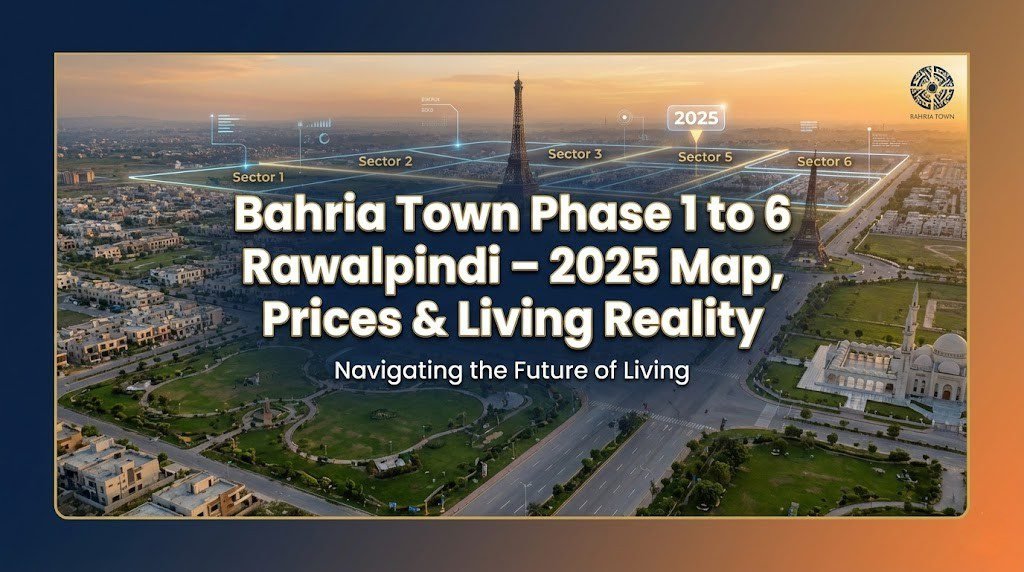
Bahria Town Phase 1 to 6 Rawalpindi (commonly branded as “Bahria Town Islamabad”) form the original core of the Bahria brand in the Twin Cities. These phases were launched in the late 1990s as a private “city within a city” with underground electrification, controlled access and a managed municipal system at a time when such planning was rare in Pakistan.
Today, Phases 1–6 are fully built, densely populated and function as an upper-middle-class belt between GT Road Rawalpindi and Islamabad’s Zone V. The area is mature, safe and commercially active, but it also faces second-generation challenges: rising utility costs, water stress and traffic pressure around Civic Center.
This blog walks through location, master plan, phase-wise character, prices, rents, utilities and investment logic for Bahria Town Phase 1 to 6 Rawalpindi in 2025, with a practical focus for buyers and tenants from Islamabad and Rawalpindi.
1. Background & Planning – How Phases 1–6 Took Shape
Bahria Town (Pvt.) Ltd was incorporated in 1997 under Malik Riaz Hussain. Phases 1–6 of Bahria Town Rawalpindi were the company’s first large-scale gated community project, conceptualised as a self-managed urban district with its own security, maintenance and service systems.
Key planning milestones:
- CDA NOC: “Bahria Town Islamabad” (covering these phases) secured a No Objection Certificate from the Capital Development Authority in July 2001, which helped build early buyer confidence.
- Topography-led design:
- Phases 1–3 – “Valley Strip”: hilly, zig-zag streets following natural contours, leading to irregular but scenic streetscapes.
- Phases 4–6 – “Lake Valley”: closer to the Soan River with more emphasis on water bodies, green belts and softer slopes.
While marketing material often uses the Islamabad tag, these phases sit mostly on the Rawalpindi side, with practical connectivity to both cities.
2. Location & Access – Bridge Between Islamabad and Rawalpindi
Phases 1–6 run off the GT Road Rawalpindi corridor, roughly 9–10 km from Saddar, and link towards Islamabad’s Zone V and DHA through a series of internal roads and bridges across the Soan River.
Key location points:
- GT Road frontage: Phase 1 acts as the main gateway; Phase 2 and Safari Villas 2 flank the approach near Toyota Rawal Motors.
- Soan River edge: Phases 3 and 4 sit close to the river; Phase 4’s Civic Center is effectively a riverfront commercial district.
- Islamabad access: Through Japan Road, Islamabad Expressway and DHA Islamabad–Rawalpindi, many residents commute daily to Blue Area, G-sides and airport-facing jobs.
For a buyer evaluating Bahria Town Phase 1 to 6 Rawalpindi, the location offers:
- Quicker reach to Islamabad offices than many inner-city Rawalpindi neighbourhoods
- A complete set of amenities (schools, hospitals, retail, parks) within the gated belt
3. Phase-by-Phase Overview – Character & Land Use
3.1 Phase 1 – Gateway and Safari Villas 1
Phase 1 is the original entrance community from GT Road and merges into nearby Gulrez and Media Town, which keeps it busy and highly visible.
Main features:
- Residential mix: Mostly 10 Marla and 1 Kanal plots, fully developed; only a small number of vacant plots remain in the resale market.
- Safari Villas 1: Pre-built designer villas on terraced land, targeted at buyers who prefer ready homes over self-construction.
- Amenities:
- Local mini markets for daily groceries
- Restaurants and cafes such as Chaaye Khana and KFC
- Mumtaz Medical Center and other clinics
3.2 Phase 2 – Education-Centric Family Belt
Phase 2 sits north of Phase 1 and links more directly towards Islamabad Expressway, making it attractive for capital-city commuters.
Highlights:
- Safari Villas 2: Close to the GT Road entrance, offering managed villa living with HOA-style maintenance.
- Ace International Academy: A major British-curriculum school that anchors the phase and draws many families.
- Parks and family pockets: Numerous small parks between streets, giving the phase a family-friendly feel.
3.3 Phase 3 – Executive Lodges and Scenic Plates
Phase 3 occupies dramatic terrain between the Korang and Soan river channels. Access comes via internal bridges from the earlier phases.
Key components:
- Executive Lodges: Large 2 Kanal and bigger plots with mansion-style homes, private lawns and higher privacy.
- Safari Villas 3: A continuation of the villa concept with upgraded layouts.
- Mini golf and recreation: Phase 3 includes a mini golf facility and park network, adding to its higher-end residential character.
3.4 Phase 4 – Civic Center and Riverfront Commercial Hub
Phase 4 is the commercial heart of Phases 1–6. It wraps around the Soan River banks and houses the Civic Center, a full central business district.
Civic Center features:
- Multi-storey plazas with banks, corporate offices and retail brands (Burger King, Pizza Hut and others).
- The Arena gold-class cinema and entertainment complex.
- River view commercial buildings along the Soan edge.
Residential blocks exist in Phase 4 but carry higher noise and traffic levels due to the commercial intensity, which is reflected in both prices and rental demand.
3.5 Phase 5 – Quiet Residential Core
Phase 5 functions as a quieter, residential counterweight to the commercial bustle of Phase 4.
- Plot sizes: mainly 10 Marla and 1 Kanal.
- Spirit Park: One of the main parks in the 1–6 cluster, with walking tracks and green buffers.
- Good connectivity to Civic Center, yet still shielded from the most intense traffic.
3.6 Phase 6 – Northern Completion & Jamia Mosque
Phase 6 completes the Phases 1–6 group on the northern side.
- Road layout: Broad metalled roads and a layout that optimises land between Soan River and internal arterials.
- Phase 6 Jamia Mosque: A landmark air-conditioned mosque with dedicated women’s section, serving as a strong community focal point.
- Rapid access to Phase 4’s Civic Center within a short drive, which keeps Phase 6 well-linked despite its comparatively calmer residential character.
4. Commercial Ecosystem – Civic Center and Mini Markets
4.1 Civic Center, Phase 4 – Flagship Commercial District
Civic Center is the main commercial engine for Bahria Town Phase 1 to 6 Rawalpindi.
Approximate 2025 market indicators:
- 5 Marla commercial plots: around PKR 57.5 million – 70 million, with riverfront and main boulevard plots at the upper end.
- Larger commercial plots (15 Marla+): stretching from roughly PKR 200 million – 450 million, depending on frontage and exact location.
- Retail shops (small units under ~500 sq ft): about PKR 5.5 million – 15 million in resale.
- Office rentals: often in the PKR 170,000 – 450,000 per month band for 2,500+ sq ft corporate offices, depending on finish and tower.
Vacancy rates remain low because Civic Center serves the entire Bahria 1–7 catchment and draws in traffic from DHA and adjacent localities.
4.2 Mini Commercial Markets in Phases 1, 2, 3, 5, 6
Each residential phase hosts its own “Mini Commercial” zone with:
- Grocers, pharmacies and bakeries (including chains like Tehzeeb Bakers)
- Dry cleaners, clinics, salons and small eateries
Prices in these mini markets sit below Civic Center rates but offer steady rental performance because they host daily-use services. Investors who prefer defensive income often lean towards these neighbourhood commercial strips instead of large plazas.
5. Residential Market – 2025 Prices & Rents
5.1 Plot Prices – 10 Marla and 1 Kanal
Phases 1–6 are fully developed with very few open plots, which keeps supply tight and valuations firm.
Indicative 2025 ranges for residential plots:
- 10 Marla plots: roughly PKR 21.5 million – 29.5 million
- 1 Kanal plots: about PKR 35.0 million – 62.5 million, with prime corners, park-facing and wider-boulevard plots at the higher end
Phase-wise differences exist:
- Phase 3 Executive Lodges and river-view patches trend higher within each size band.
- Phase 5 and 6 10 Marla plots sometimes show slightly narrower ranges due to more uniform residential usage.
5.2 House Prices – Traditional Houses & Safari Villas
Constructed house prices depend heavily on age, finishing and location. Current broad ranges:
- 10 Marla houses: around PKR 42.5 million – 59 million
- 1 Kanal houses: approximately PKR 68 million – 130 million, with newly built designer houses in Phase 3 and 4 touching the upper bracket
Safari Villas (Phases 1–3) remain a separate micro-segment:
- 5 Marla Safari Villas: about PKR 20.6 million – 35 million
- 10 Marla Safari Villas: roughly PKR 35 million – 67.5 million
These are especially popular among overseas Pakistanis who prefer maintenance-managed, homogeneous streets.
5.3 Rental Market – Strong End-User Demand
The rental market in Bahria Town Phase 1 to 6 Rawalpindi is active because of:
- Security and controlled environment
- Proximity to DHA and Islamabad offices
- Availability of schools and hospitals within the gated belt
Approximate 2025 rents:
- Apartments / portions (1–2 bed): around PKR 25,000 – 45,000 per month
- 10 Marla houses: roughly PKR 80,000 – 130,000 per month
- 1 Kanal houses: around PKR 150,000 – 250,000 per month
Yield-focused investors often prefer 10 Marla and lower-end 1 Kanal houses in established streets where tenancy risk is low and turnaround time is short.
6. Infrastructure, Utilities & Challenges
6.1 Electricity – Private Grid, Public Risk
Bahria Town runs its own internal grid for Phases 1–6 through a private supply company, historically marketed as protection from national load-shedding. Tariffs, however, tend to be higher than standard DISCO rates and include fixed charges.
Recent events in Lahore highlight systemic risk: in November 2025, Dawn reported that power to several Bahria Town Lahore projects was cut due to unpaid dues of around Rs 682 million, before being restored after settlement.
While that incident involved a different city, it underlines a structural point:
- Residents depend on Bahria’s corporate ability to pay bulk supply bills.
- Long-term planning increasingly includes solar systems and backup solutions.
6.2 Water – Falling Aquifer and Dependence on Tankers
Phases 1–6 rely on tube wells and internal distribution, backed by water tankers. As population density has risen, the water table in Rawalpindi’s belt has dropped, and many households report periodic shortages, especially in summer.
Parallel to that, the government and WASA are working on Daducha and other dams to improve Rawalpindi’s bulk water supply; a 2025 Dawn report notes feasibility studies and planning for 35 MGD from Daducha to the city, and the provincial government has directed completion by late 2025.
Until such projects are fully operational and linked into Bahria’s systems, buyers in Bahria 1–6 should:
- Confirm actual water pressure and timing at street level
- Factor in monthly tanker cost where relevant
6.3 Security & Maintenance
Security remains a core selling point:
- Boundary walls, controlled entry gates and a private security force
- Widespread CCTV coverage in commercial and key intersections
As the Civic Center and river bridges have grown busier, the environment feels more urban than it did two decades ago, but still more controlled than open parts of Rawalpindi.
Maintenance fees cover garbage collection, green belts, streetlights and security. Charges have followed an upward trend across Bahria projects (for example, a documented 20% increase in Karachi maintenance fees in 2024), which indicates similar pressure in Rawalpindi.
7. Parks, Recreation & Lifestyle
Phases 1–6 are heavily landscaped relative to most city areas. Key leisure features include:
- Spirit Park in Phase 5, Phase 1 parks and Executive Lodges Park in Phase 3
- Glow Park with illuminated installations near the main access
- Small zoos and bird aviaries in Phases 2 and 3, used by families as weekend attractions
- Monuments and themed roundabouts that give the scheme its recognisable identity
Combined with Civic Center’s restaurants, cafes and Arena cinema, these features help Phases 1–6 maintain a distinct lifestyle appeal compared to conventional urban sectors.
8. Legal Context & Risk Profile
From a regulatory standpoint:
- CDA NOC (2001) for “Bahria Town Islamabad” provided a framework for early development.
- Subsequent litigation around Bahria Town in Karachi and some Rawalpindi assets has led to auctions of certain marquee properties and fines linked to competition issues (for example, denial of rights of way to Nayatel, as noted by the Competition Commission).
For Phases 1–6 specifically:
- These phases are considered fully developed with possession across the board; there are no entire blocks classified as non-possession. Vacant plots are usually just unconstructed holdings, not undeveloped land.
- Buyers should still verify each plot’s status at Bahria’s transfer office and, where necessary, cross-check encumbrances or pending disputes.
Compared with speculative areas in Phase 8 and its Extension, Phases 1–6 offer lower planning risk and more emphasis on operational cost and lifestyle trade-offs.
9. Who Bahria Town Phase 1–6 Suits – And Who Should Be Cautious
Based on price levels, maturity and infrastructure, Bahria Town Phase 1 to 6 Rawalpindi fits:
- Upper-middle and high-income families seeking:
- Gated security and landscaping
- Ready access to schools, hospitals and Civic Center
- A built-out environment with little construction noise relative to newer schemes
- Investors focused on stability and rental income, not aggressive speculation
- Overseas Pakistanis who want managed villas or modern houses in a community that already has services and community life in place
Caution is warranted for:
- Households with tight monthly budgets, due to higher electricity tariffs, water management costs and maintenance fees
- Buyers who only want state-backed projects with uniform government-run utilities (in such cases, DHA or CDA sectors may feel more aligned with expectations)
10. How Property AI Helps You Navigate Phases 1–6
The 1–6 cluster hosts multiple phases, villa compounds, commercial belts and micro-markets, each with different price patterns and rental behaviour. Going sector by sector purely through ads can become confusing.
Property AI – Pakistan’s 1st AI Property Agent is designed to add structure to that decision. Through Property AI, you can:
- Review different cities and projects from the dedicated Property AI cities section.
- Shortlist Bahria Town Phase 1 to 6 Rawalpindi segments that match your budget, plot size and residential or investment goals.
- Align expectations for house prices, rental ranges and likely holding horizon before entering negotiations.
If you need personalised help for a specific street, villa pocket or commercial building, you can reach the team through the Property AI contact page.
For fast comparison questions (for example, Phases 1–6 vs Phase 8 vs DHA), you can also chat directly with the Property AI bot here: Property AI – Pakistan’s 1st AI Property Agent.
FAQs – Bahria Town Phase 1 to 6 Rawalpindi
1. Is Bahria Town Phase 1 to 6 in Islamabad or Rawalpindi?
Phases 1–6 physically sit in Rawalpindi along the GT Road and Soan River belt, but they are frequently marketed as “Bahria Town Islamabad” because part of the planning area falls in Zone V of the capital and residents commute heavily towards Islamabad. Administrative handling and many municipal matters, however, remain tied to Rawalpindi.
2. What are typical 10 Marla and 1 Kanal prices in Bahria Town Phase 1–6?
In 2025, 10 Marla plots in Bahria Town Phase 1 to 6 Rawalpindi generally sit around PKR 21.5 million – 29.5 million, while 1 Kanal plots mostly range between PKR 35.0 million – 62.5 million, depending on phase, street, corner status and proximity to Civic Center or key parks. Constructed houses cost more, with 10 Marla houses often above PKR 42.5 million and 1 Kanal houses stretching beyond PKR 68 million.
3. How strong is the rental market in Bahria Town Phases 1–6?
Rental demand is healthy because the phases combine secure living, reputable schools and access to Civic Center. Typical monthly rents are around PKR 25,000 – 45,000 for 1–2 bed units, PKR 80,000 – 130,000 for 10 Marla houses, and PKR 150,000 – 250,000 for 1 Kanal houses, with exact figures affected by condition, furnishing and micro-location.
4. Are Phases 1–6 fully developed or still under construction?
Phases 1–6 are considered fully developed. Roads, sewerage and utilities exist throughout, and there are no entire blocks officially tagged as non-possession. The only “empty” lots are privately held plots where owners have not yet constructed a house. This is very different from Phase 8 and its Extension, where large sections remain under active development.
5. What are the main risks or downsides of living in Bahria Town Phase 1–6 Rawalpindi?
Primary pain points include higher electricity tariffs due to the private grid, periodic water shortages that may require tanker use, rising maintenance fees, and growing traffic load around Civic Center and Soan bridges. Broader Bahria-wide legal and financial disputes in other cities also make some buyers cautious, so proper verification of each property’s status before purchase is important.