
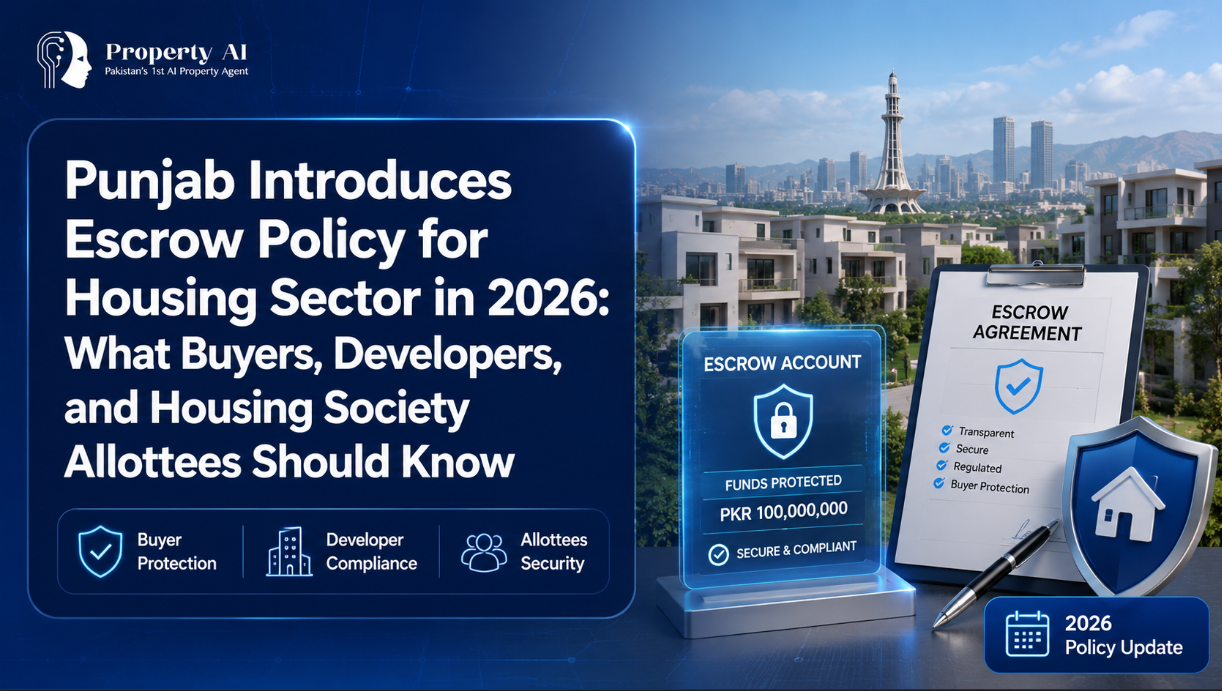
As of May 2026, Punjab’s move toward an escrow policy for the housing sector is no longer just market talk. Official Punjab Assembly listings show The Punjab Housing and Town Planning Agency (Amendment) Bill 2026 as passed, and the publicly visible amendment text indicates that housing schemes will be required to maintain a jointly operated escrow account for money collected from allottees or buyers. The same official snippet also indicates that only a controlled portion of those funds can be used for project-related expenses, which points to a tighter, project-specific spending model.
For buyers, this matters because the reform is clearly aimed at better protection, tighter fund control, and cleaner project transparency For developers and sponsors, it means buyer money is expected to be ring-fenced more carefully than before. For people searching Punjab escrow account online, Punjab escrow account registration, Punjab escrow account opening online, or Punjab escrow account opening, the key point is this: the publicly visible reform is focused on scheme-level compliance, not a simple buyer-side self-service portal.
If you are comparing housing societies, project risk, and location options in Punjab before moving into legal documentation, the Property AI chatbot is a practical first step, and the Property AI city pages help place those projects in a broader market context.
What has actually changed in May 2026?
The most important update is that this is no longer just an idea circulating in videos or property circles. Official Punjab Assembly pages show the Punjab Housing and Town Planning Agency (Amendment) Bill 2026 moving through the legislative process and being listed as passed. Assembly business pages for April 22, April 29, and May 4, 2026 also show the bill being scheduled to be moved for passage, which supports the view that the reform is now in the formal legislative track rather than only in discussion.
The second major point is the escrow mechanism itself. The publicly visible official Gazette snippet tied to the amendment indicates the establishment of a jointly operated escrow account for amounts collected from allottees or buyers, with controlled use of funds for project-related spending. That is the real policy shift. The government is not simply telling schemes to “be more transparent.” It is moving toward a structure where buyer funds are more directly tied to the development of the same project from which those funds were collected.
What an escrow policy means in the housing-sector context
In practical terms, an escrow arrangement means buyer payments are not supposed to flow into a loose, freely spendable pool. Instead, the money sits inside a controlled account under defined rules, with an extra layer of oversight on how and when it is used. In the context of housing societies and real-estate development, that matters because one of the oldest complaints in the market is that allottees pay into a project, but the funds are then diverted, delayed, or spread into other activities.
That is why this reform matters beyond legal language. A properly enforced escrow model can reduce some of the most common buyer risks:
- money collected for one scheme being used elsewhere,
- early-stage payments disappearing into non-development expenses,
- slower delivery because project cash flow is not protected,
- and weaker accountability when buyers demand possession or progress updates.
Punjab escrow policy at a glance
| Area | What the official May 2026 trail indicates | Why it matters |
|---|---|---|
| Legal status | Punjab Assembly listings show the PHATA amendment bill as passed | The escrow idea has moved into formal lawmaking territory |
| Escrow structure | Publicly visible amendment text points to a jointly operated escrow account | Buyer funds appear set to face stronger control |
| Source of funds | Amounts collected from allottees or buyers | The model is directly tied to housing-scheme collections |
| Use of funds | Official snippet suggests controlled use for project-related expenses, with a capped usable portion | The policy is aimed at reducing diversion of project money |
| Target sector | Housing schemes / housing-sector development framework | This is not a generic banking rule; it is sector-specific |
| Buyer impact | Stronger transparency and better project-fund discipline if implemented properly | Can reduce delivery risk and documentation anxiety |
Why Punjab is moving in this direction
Punjab’s housing market has long struggled with one major trust problem: buyers often pay early, but project execution does not always match the cash collection story. When that happens, allottees are left with delayed development, weaker possession timelines, and endless disputes around where the money went. An escrow framework is designed to attack exactly that weakness by linking collections more tightly to the same project.
This also fits the wider pattern seen in recent Punjab property reforms. Over the last few months, the province has already moved toward:
- tighter property documentation rules,
- lower and more uniform stamp-duty treatment,
- stronger ownership-protection language,
- and more visible attempts to reduce fraud and litigation in property handling.
So the escrow policy is not an isolated move. It fits into a broader push toward more traceable and better-documented real-estate activity in Punjab.
What this means for housing-society buyers
For buyers, this is one of the more meaningful structural changes in recent months. If implemented properly, an escrow-based model can make the market safer in at least four ways.
1) Better fund protection
A buyer paying into a society wants that money to stay tied to the same scheme. An escrow arrangement is meant to improve exactly that.
2) Better transparency
If funds are collected into a structured account and released in a controlled way, it becomes easier to ask what money was received and how it was used.
3) Lower project-diversion risk
A major fear in the housing market is that one scheme’s buyers end up financing delays or gaps elsewhere. Escrow is designed to reduce that.
4) Better confidence for genuine buyers
A cleaner fund trail can make serious buyers more comfortable with documentation, installment plans, and development claims.
This does not mean every risk disappears. A bad project can still be a bad project. However, it does mean the financial handling side could become less loose than before if the mechanism is enforced properly.
What this means for developers and sponsors
For developers, the escrow requirement changes the way buyer money can be treated. The main shift is not just accounting. It is control.
A developer or sponsor will have to operate in a framework where:
- collections are more visible,
- project-spending justification matters more,
- and the use of buyer funds appears to be more tightly tied to project-related activity.
That can feel restrictive from a developer’s side. Even so, it can also improve confidence for serious buyers, lenders, and overseas Pakistanis who are often cautious about entering projects with weak financial discipline. In the medium term, a cleaner fund model can help stronger developers stand out from weaker ones.
Punjab escrow account online, registration, and opening: what people should understand
A lot of people are now searching:
- Punjab escrow account online
- Punjab escrow account registration
- Punjab escrow account opening online
- Punjab escrow account opening
That search behavior makes sense, but the official material visible right now points more toward a scheme-level compliance requirement than an ordinary buyer opening a personal escrow account through a public online portal. In other words, the burden appears to sit primarily on the housing scheme / sponsor side, with the escrow structure attached to the project’s collection and spending system.
So the safer expectation as of May 2026 is this:
- buyers will likely interact with an escrow-backed project framework,
- housing schemes will likely be the ones required to establish and operate the escrow mechanism,
- and more practical implementation details may still depend on follow-up rules, notifications, banking arrangements, or departmental instructions.
That means buyers should not assume there is already a simple Punjab government self-service form for “escrow account opening online.” The public legislative signal is real, but the consumer-facing implementation layer may still take time to become fully visible.
Why this matters so much in Rawalpindi and Islamabad-side market behavior
Even though the reform is about Punjab’s housing sector, its practical impact is especially relevant in places where buyers compare:
- approved and unapproved societies,
- file-based and plot-based inventory,
- early-stage and late-stage projects,
- and projects near the Rawalpindi-Islamabad belt where developer credibility matters heavily.
That is why this issue is not only for lawyers or sponsors. It directly affects ordinary users deciding whether to trust a payment plan, down payment schedule, or early launch booking. If you are weighing whether a project looks serious or only sounds serious, start with the Property AI city pages for broader market context, then use the Property AI chatbot to narrow by location, stage, and budget before dealing with project paperwork.
Decision guidance: who should pay extra attention now?
Buyers in under-construction societies
You should pay close attention because escrow is directly relevant to how your installment money is handled.
Overseas Pakistanis
This reform matters to you because distance increases trust risk. A stricter collection model can improve confidence if enforced properly.
Families buying from launch-stage projects
Early-stage buyers often face the highest uncertainty around delivery. Escrow is meant to improve that part of the risk chain.
Developers with strong documentation
This may help you because transparent operators usually benefit when the market moves away from loose financial handling.
Buyers searching only by price
You should be careful not to treat “escrow policy” as automatic safety. It is a positive sign, but it does not replace due diligence on approvals, layout, NOC position, and title history.
What this reform does not solve by itself
This is a useful reform, but it does not magically solve every housing-society problem.
It does not automatically:
- legalise a weak project,
- replace approval verification,
- erase fake-file risk,
- guarantee on-time possession,
- or cure title defects.
A society can still face problems in planning, approvals, development quality, or documentation even if the policy direction is better. So the correct reading is this: escrow improves the money-handling side, but buyers still need to verify the project itself.
Final verdict
Punjab’s housing-sector escrow policy is one of the more important real-estate governance shifts of 2026 because it targets one of the market’s oldest weak points: what happens to buyer money after it is collected. As of May 2026, the official legislative trail shows that the Punjab Housing and Town Planning Agency (Amendment) Bill 2026 has moved through the assembly and is listed as passed, while the amendment text visible publicly points to a jointly operated escrow account for amounts collected from allottees or buyers.
For buyers, that is a meaningful sign in favor of transparency and fund protection For developers, it signals tighter discipline. For the market overall, it suggests Punjab is trying to move housing schemes toward a structure where money collected for a project is treated more like trust money and less like unrestricted cash flow. That does not remove the need for due diligence, but it does strengthen the buyer-protection side of the conversation.
FAQs
What is Punjab’s escrow policy for housing schemes?
As of May 2026, the publicly visible amendment trail indicates Punjab is moving housing schemes toward a jointly operated escrow-account system for amounts collected from allottees or buyers.
Has Punjab officially passed the escrow-related housing amendment?
Official Punjab Assembly listings show The Punjab Housing and Town Planning Agency (Amendment) Bill 2026 as passed.
Does this mean buyers can now complete Punjab escrow account registration online?
The public legislative material currently points more clearly to scheme-level escrow compliance than to a public buyer-side registration portal. Buyers should expect implementation details to come through the project and regulatory framework rather than assume a standalone self-service account-opening system already exists.
Why is the escrow policy important for housing-society buyers?
Because it is aimed at improving fund control, reducing diversion risk, and tying buyer payments more closely to the same project for which the money was collected.
Does escrow policy alone make a housing society safe?
No. It helps on the financial-control side, but buyers still need to verify approvals, title, layout, development progress, and legal status before paying.