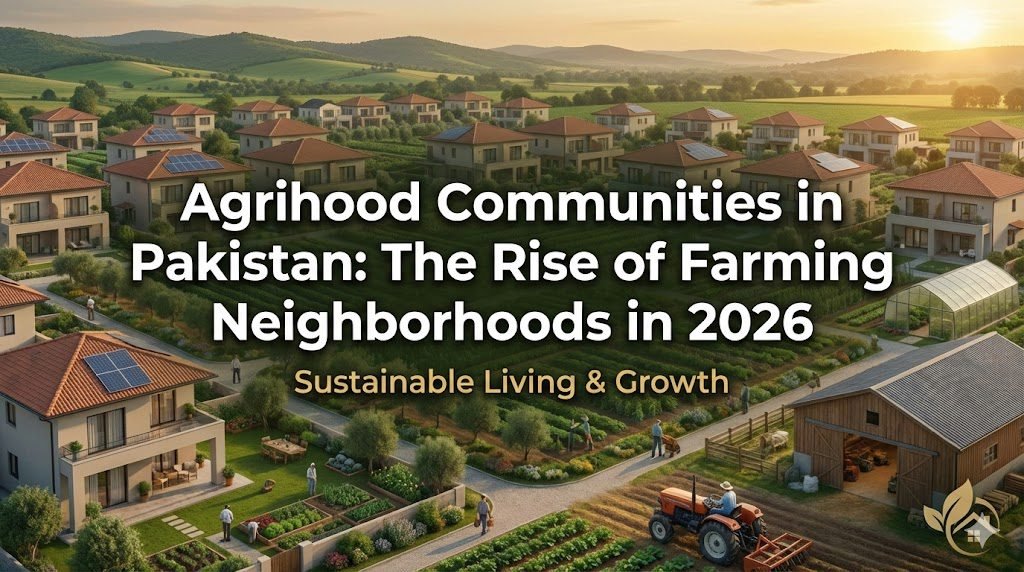
Agrihood communities in Pakistan are starting to move from a “farmhouse dream” into a more organized way of living—where a working farm, orchard, or community-grown produce is built into the neighborhood plan. In 2026, this idea fits Pakistan’s reality: food inflation pressure, higher awareness around clean eating, and a growing preference in Islamabad and Rawalpindi for semi-rural living that still stays connected to the city. At the same time, buyers are more cautious than before; land title, access roads, water reliability, and approvals matter as much as the lifestyle.
An agrihood is not simply a plot near fields. It is a community where farming is a planned feature: land is reserved for cultivation, there is a defined management model, and residents get value through produce access, shared green space, and in some cases small-scale agro-tourism. Internationally, the term is used for “agriculture + neighborhood” developments built around a farm or food production.
What “agrihood” means in practical terms
Agrihood communities in Pakistan, when done properly, combine four elements:
A permanent farming core
This is the non-negotiable difference. A real agrihood keeps farming land protected inside the master plan. It could be an orchard belt, a shared vegetable farm, greenhouses, or livestock kept within defined boundaries. The farm is not a marketing photo; it is a long-term land allocation with a working plan.
A community model, not just private plots
Agrihoods usually involve shared services: farm management, composting, irrigation planning, and produce distribution. Even if residents own separate plots or homes, the farm area is governed through a structure similar to a society management committee or professional operations team.
Food access as a resident benefit
Some communities offer weekly produce boxes, an on-site farm shop, or partnerships with nearby growers. In Pakistan, even a simple resident-only produce counter can become a strong value driver if it is consistent and managed.
Green-first design that impacts daily life
This includes walking trails, farm-to-kitchen concept spaces, shaded community areas, and low-density planning that protects open land. In Islamabad and Rawalpindi, this often overlaps with what buyers already like: privacy, greenery, and distance from congestion.
Why agrihood living is becoming attractive in 2026
The shift is not only lifestyle; it is also a reaction to market conditions.
Food reliability and trust
Households that can afford premium living are also more alert about food quality, pesticide use, and supply disruptions. A community farm is seen as a “controlled source,” even if it covers only part of household consumption.
Semi-rural living is already normal in the twin cities market
Islamabad and Rawalpindi have long had demand for farmhouse belts, orchard-side properties, and low-density living near major routes. The difference now is the preference for managed communities rather than isolated land.
Wellness trends are tied to property decisions
Walking areas, natural light, cleaner air, and quiet surroundings are being treated as property features—not extras. For many buyers, farm-based neighborhoods feel more practical than heavily themed “luxury” concepts.
Agriculture still anchors Pakistan’s economy
Agriculture’s role in employment and national planning remains central, and official data collection around agriculture continues to expand, including the integrated agricultural census activities. This keeps farming, land use, and rural value connected to policy and long-term national priorities, which matters when a housing model is built around agriculture.
Where agrihood-style communities fit around Islamabad and Rawalpindi
Agrihood communities in Pakistan make the most sense in peri-urban corridors—areas close enough for commuting but still capable of sustaining farming activity.
Islamabad-side corridors
Demand often clusters around routes where buyers can reach the city without losing the semi-rural feel. In practical terms, these areas usually share common traits:
- Land parcels historically used for orchards or small farming
- Access through main roads leading to Islamabad sectors
- Buyers who want greenery but cannot commit to fully rural living
In Islamabad’s broader surroundings, buyers also care about zoning realities: some land is not meant for dense residential development, and some areas carry specific land-use expectations. For lifestyle buyers, this is not a problem as long as the project matches the land-use category and documentation is clean.
Rawalpindi-side corridors
Rawalpindi has a wider spread of mixed-use and semi-rural belts where farming and housing mix naturally. Here, the market often includes:
- Mixed buyer intent (weekend use + future build)
- Higher sensitivity to access roads and daily commute
- Stronger focus on price-to-land value compared to Islamabad
For agrihood-style planning, Rawalpindi-side communities also need stronger infrastructure discipline, because unmanaged development can quickly damage the core feature: farm land.
Agrihood vs farmhouse: the difference buyers must understand
In the twin cities market, “farmhouse” is a familiar word, but it often covers very different realities.
A farmhouse cluster can still be a weak product
Many farmhouse areas have no community governance, weak water planning, limited security, and no shared green benefit beyond private boundaries. Farming is usually outside the community, not inside it.
An agrihood requires land protection
If the master plan allows the farm area to be converted into extra plots later, the agrihood claim is fragile. Buyers should treat that as a red flag, because the “farm feature” can disappear after early sales.
Farming must be operational
If there is no plan for farm staffing, inputs, irrigation, harvesting, and distribution, the farm will become decorative landscaping. That lowers value over time.
The economics: what drives value in farming neighborhoods
Agrihood communities in Pakistan sit between two value systems: conventional real estate pricing and productive land value.
Land value plus livability premium
A well-managed farm-based community often earns a premium because buyers pay for:
- Green density (open land protected from future overcrowding)
- A “clean living” environment
- Community services that reduce the burden of managing property alone
Water is a pricing lever
Water planning is one of the most overlooked issues in lifestyle communities. If water is unreliable, farming cannot survive, landscaping declines, and resale weakens. Projects that build clear solutions—legal water sources, storage, irrigation systems—usually hold value better.
Power stability matters more than branding
Solar and backup systems are not only “comfort”; they can be operational infrastructure for irrigation pumps and cold storage for produce. In 2026, buyers often treat power resilience as part of the property’s long-term usability, especially outside core city zones.
Operating cost affects long-term satisfaction
A farm-based community needs ongoing operations: staff, inputs, maintenance, pest control, and community management. If that cost is not structured properly, residents face either rising charges or a decline in farm quality.
What a strong agrihood master plan looks like
A serious agrihood plan is easy to recognize when you know what to check.
Farm land share and placement
- The farming core should be central or meaningfully integrated, not pushed to a leftover corner
- A defined buffer from residential areas reduces conflict over smell, insects, and machinery
- Orchard belts can work well because they require less daily disruption than vegetable farms
Farm operations plan
- Who runs the farm: developer team, outsourced farm operator, or resident-managed system
- What is grown and why: climate fit, soil suitability, harvest cycle planning
- Distribution method: farm shop, weekly box, resident credits, or open sale with resident priority
Community governance structure
If a project is a managed community, it needs enforceable rules. Without governance, farming land gets pressured by:
- Encroachment
- Illegal construction
- Short-term commercial use
- Neglect due to disputes
Roads and access that protect the farm
Farm operations require movement of inputs and harvest. Roads must handle utility vehicles without destroying internal landscaping or creating dust problems that impact residents.
Legal and due diligence points for buyers in Pakistan
Agrihood communities in Pakistan cannot be evaluated only on lifestyle. Documentation and approvals are central, especially near Islamabad and Rawalpindi where different authorities apply depending on location and land category.
Title and ownership chain
Buyers should confirm:
- Clear ownership records and mutation trail where relevant
- No disputed land history
- Proper subdivision documentation where applicable
Authority alignment
Depending on where the project sits, buyers may need to verify relevant approvals and compliance expectations with the applicable authority. In the twin cities region, the approval environment can include bodies responsible for planning, housing scheme regulation, or development controls.
Land-use reality
If the land is primarily agricultural by category, the community must match what is legally permissible. Farm-based living can work in agricultural land contexts, but dense residential promises on agricultural land can become risky.
On-ground verification
Agrihood claims can be tested by visiting:
- Is farming already active?
- Are there irrigation lines, water storage, and soil prep?
- Is farm land protected from plot cutting and construction creep?
Who typically buys into agrihood-style communities
In the Islamabad–Rawalpindi market, demand usually comes from distinct buyer groups:
End-users seeking daily livability
These buyers want:
- Quiet living
- Green environment
- A healthier daily routine
They care about access roads, security, and utilities more than speculative resale.
Weekend and seasonal users
They use the property as a second home. Their biggest concerns are management reliability, safety, and maintenance when they are away.
Long-hold investors
They are less focused on quick flips. They want:
- Stable value preservation
- A community that will not degrade over time
They evaluate developer discipline and governance structure closely.
Risks that can quietly damage agrihood value
Even well-marketed communities can fail if these problems are ignored:
Farming becomes symbolic
If produce cycles stop, the farm becomes a landscaping expense. Buyers then feel they paid for a feature that doesn’t exist.
Water conflict
If residents compete with farm operations for limited water, disputes become routine and community satisfaction drops.
Weak governance
Without enforcement, unauthorized construction and land misuse slowly destroy the “green-first” promise.
Overselling yield claims
Some projects imply that farming will generate large income for residents. In practice, small-scale community farming can offset costs or provide produce value, but it needs careful management to become income-positive.
A practical way to compare areas and shortlists
For buyers comparing multiple corridors around Islamabad and Rawalpindi, shortlisting becomes easier when you separate three layers:
- Legal layer (documentation and authority alignment)
- Infrastructure layer (water, power, roads, security)
- Lifestyle layer (farm integration and community design)
When you are comparing verified project options across the twin cities, browsing location-wise listings in Property AI Cities can help structure the shortlist around area context rather than marketing claims. Keep the comparison grounded in documentation and on-ground readiness, then evaluate lifestyle fit.
Conclusion: where this trend is heading
Agrihood communities in Pakistan are positioned to grow because they align with what many families in Islamabad and Rawalpindi already value: greenery, privacy, and a more controlled living environment. The difference in 2026 is the rising demand for managed communities that protect open land and deliver consistent services, instead of isolated plots that depend entirely on individual effort.
The strongest agrihood-style communities will be the ones that treat farming as infrastructure: protected land allocation, real operations, water planning, and governance. Buyers who verify these basics will get a product that stays livable and holds its appeal even as the market shifts. If you want a quick way to sanity-check a community’s claims, a short conversation with the Property AI Bot can help you list what to verify before you commit—especially around approvals, location context, and on-ground development signs.
FAQs
1) Are agrihood communities in Pakistan legally approved housing schemes?
They can be, but approval depends on location, land category, and the governing authority. Buyers should verify documentation and compliance with the relevant authority for the specific area before committing.
2) What makes agrihood communities in Pakistan different from farmhouses near Islamabad?
Farmhouses are often individual properties without shared farming infrastructure. Agrihoods keep a permanent farm core inside the plan, run operations through a defined model, and provide shared benefits like produce access and protected green space.
3) Do agrihood communities provide financial returns through farming income?
Farming can offset some costs and provide produce value, but strong income claims are usually unrealistic without professional operations, scale, and a clear distribution model. Buyers should treat farming benefits as lifestyle value first.
4) What is the biggest utility risk in farm-based communities around Rawalpindi?
Water reliability. If a community does not have a stable and legally workable water plan, both farming and landscaping decline, and long-term satisfaction drops.
5) What should buyers check first when evaluating a farming neighborhood concept?
Start with land title clarity and authority alignment, then verify on-ground farming operations and water infrastructure. If farming is only a marketing point, the concept will not hold over time.
Disclaimer: Information is for awareness, subject to change, and buyers should verify approvals and details independently.