
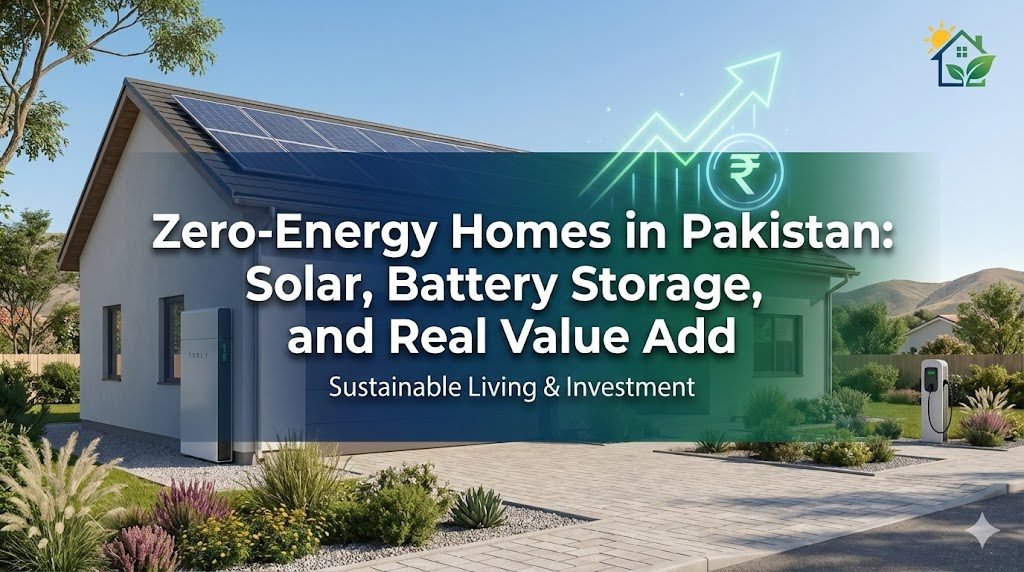
Zero-energy homes in Pakistan are no longer a “future concept” reserved for luxury builds. In Islamabad and Rawalpindi, rising electricity bills, load management, and the growing preference for reliable backup are pushing buyers to treat energy performance as a serious part of home value. A zero-energy home targets a simple outcome: over a year, the home produces as much usable energy as it consumes, mainly through rooftop solar paired with efficiency upgrades and, increasingly, battery storage.
This matters in the twin cities because the buyer mindset is changing. People still care about location, access, and approvals, but they also ask practical questions: “Backup kitna strong hai?”, “Bijli ka bill kitna aata hai?”, and “Solar ka system legal/net metering pe chal sakta hai?” A well-planned zero-energy home answers those questions with less guesswork and more measurable performance.
What “zero-energy” means in a Pakistan housing context
A zero-energy home is not just “solar laga hua ghar.” It’s a balance between:
- Energy demand (consumption): air conditioning/heating, lighting, water heating, appliances, pumps, and backup behavior
- Energy supply (production): rooftop solar generation across seasons
- Energy management (control): hybrid inverter settings, battery charging logic, and load prioritization
- Building efficiency (reduction): insulation, glazing, shading, airtightness, and efficient equipment that reduce the size and cost of the solar + battery setup
In Islamabad and Rawalpindi, the biggest mistake is treating solar as a patch over inefficient consumption. A home with poor insulation, heat gain through glass, and oversized cooling loads can “look” solar-ready, but it will struggle to hit a true zero-energy target without expensive oversizing.
Why zero-energy homes are becoming a value signal in 2026
1) Reliability is now part of livability
Backup is not a nice-to-have in many neighborhoods. Buyers assess whether the home can run fans, lights, internet, and essential appliances during interruptions without falling back to noisy generators.
2) Monthly running cost matters more than the sticker price
Even when the market is calm, families compare monthly operating cost. A home that consistently controls electricity spend can feel safer than a slightly cheaper home with unpredictable bills.
3) Resale buyers ask tougher questions
The resale conversation has evolved. Instead of only “marla, location, and possession,” buyers now ask: solar brand, inverter type, battery size, warranty, and whether the installation is compliant with utility/net metering requirements.
The three pillars of a zero-energy home
Pillar 1: Reduce demand first (the cheapest “generation” is the unit you never consume)
A realistic zero-energy build in Pakistan starts with demand reduction. The returns are immediate and permanent.
Building envelope upgrades that matter most
- Roof insulation: In the twin cities, roof heat gain is a major driver of summer cooling load. Even moderate insulation cuts peak load, improving comfort and reducing the solar/battery size required.
- Quality glazing and shading: Large glass areas look premium but can spike cooling needs. External shading, reflective films (when appropriate), and better window seals can reduce HVAC runtime.
- Air leakage control: Gaps around doors/windows let in dust and hot air, forcing cooling systems to work harder.
Equipment choices that change the math
- Inverter ACs with sensible sizing: Oversized AC units short-cycle and waste energy. Sensible sizing and efficient models often outperform “bigger is better.”
- Efficient fans and lighting: Basic, but real—high-efficiency fans and LED lighting reduce baseline consumption.
- Smart load scheduling: Running heavy loads when solar production is high can reduce reliance on batteries and reduce net grid draw.
Pillar 2: Solar PV that matches roof reality (not brochure capacity)
Rooftop solar is the main production engine in zero-energy homes. The goal is not a headline number; it’s stable generation across real-world constraints: dust, shading, roof layout, and seasonal angle of sun.
Roof feasibility checkpoints (Islamabad/Rawalpindi)
- Shading: Water tanks, stair headrooms, parapet walls, and nearby structures reduce generation. Even partial shade can impact output.
- Orientation and tilt: Not every roof allows ideal tilt; a good design adapts with layout and string planning.
- Structural integrity: Older roofs and poorly finished slabs require careful mounting and waterproofing to avoid long-term seepage.
- Maintenance access: Panels need periodic cleaning; safe access matters for long-term performance.
Pillar 3: Battery storage as a comfort-and-value layer
Battery storage is where “solar savings” becomes “solar lifestyle.” It supports:
- Backup during outages
- Smoother evening use (when solar production drops)
- Stable power for internet, security systems, and essential appliances
- Better load management through hybrid inverters
In the twin cities, batteries are also a resale feature because buyers attach value to independence: fewer interruptions, less generator noise, and better control of essential loads.
Battery sizing thinking (without overcomplicating it)
A practical approach is to size batteries around essential loads (lights, fans, internet, refrigerator, a few sockets) and then decide whether the household wants partial AC backup. Full-house AC backup can dramatically increase battery requirement and cost, so it should be a conscious choice, not an assumption.
Net metering and legal compliance: where many “good systems” fail
A zero-energy home becomes far more credible when it can legally connect and settle energy export/import under the proper framework. In Pakistan, net metering sits under NEPRA’s distributed generation and net metering framework. The regulations establish definitions, eligibility, and an application/interconnection process through the relevant distribution company.
What the NEPRA framework signals to homeowners
- The regulations establish a formal framework for distributed generation using renewable energy and net metering, rather than treating it as an informal setup.
- The document defines key concepts like billing cycle and net energy billing, reflecting that export/import is treated through a structured billing approach.
- It also defines distributed generation facilities (including solar/wind) up to 1 MW, which is relevant context even though most homes are far below that threshold.
For reference, see the official document here: NEPRA (Alternative & Renewable Energy) Distributed Generation and Net Metering Regulations, 2015 (PDF).
Practical compliance checklist for homeowners
- Installer documentation: System single-line diagram, inverter specs, protection devices, and commissioning notes should be properly maintained.
- Metering clarity: A compliant system must support the utility’s metering requirement.
- Safety and protection: Proper earthing, surge protection, and safe isolation are not “extras.” They protect appliances and reduce risk.
A buyer in Islamabad or Rawalpindi may not read technical documents, but they do respond to evidence: paperwork, warranties, branded components, and a clean, safe installation.
Islamabad and Rawalpindi realities: design for local conditions
Dust and performance drift
Dust accumulation reduces solar output. A system that looks perfect on day one can underperform after a few weeks without basic cleaning routines. Homes designed with safe roof access and practical cleaning schedules maintain performance and buyer confidence.
Water pumping, motors, and backup priorities
Many homes have motors for water supply. If the motor is part of the daily routine, it must be accounted for in inverter and battery planning, or it will disrupt the “comfortable backup” experience.
Heat waves and peak demand
In peak summer weeks, cooling demand is high and solar generation patterns shift through the day. Efficiency upgrades (roof insulation, shading, better sealing) reduce the cost of meeting a zero-energy target more than simply throwing more panels at the problem.
The “value add” buyers actually pay for
A zero-energy home adds value in two ways:
1) Measurable operating cost advantage
Buyers understand cost certainty. Even when they don’t calculate payback formally, they feel the difference in monthly bills and reliability.
2) Better negotiation position during resale
A seller with a documented, compliant system can justify pricing with proof: component warranties, installer records, and evidence of performance. In a balanced market, that documentation becomes leverage.
What buyers look for during a visit
- Branded inverter and panels with warranty cards
- Clean wiring, labeled breakers, proper earthing
- Battery installation in a safe, ventilated area
- Clear explanation of backup loads and limitations
- Evidence of compliant net metering path (where applicable)
Common mistakes that reduce trust (even if the system is expensive)
- Overselling battery capacity: Promising full-house backup without the battery size to support it creates disappointment.
- Messy installation: Poor cable management, weak earthing, or unsafe battery placement creates immediate doubt.
- No documentation: A system without paperwork is treated like an informal add-on, which reduces resale confidence.
- Ignoring efficiency: Panels alone don’t fix a house that bleeds energy through roof and glass.
Where Property AI fits (without hype)
When buyers compare energy-aware homes across different neighborhoods and societies in Islamabad and Rawalpindi, the challenge is consistency: one listing says “solar installed,” another says “backup available,” but details are missing. For market comparison across areas, the Property AI cities section helps buyers browse listings with location context, while the Property AI homepage provides a single place to evaluate property options alongside practical factors like development status and buyer priorities.
Closing perspective: zero-energy is becoming a housing standard, not a luxury label
Zero-energy homes in Pakistan are trending toward a mainstream expectation in certain buyer segments—especially families who want predictable running costs and steady power for work, security, and comfort. The strongest zero-energy homes are not the ones with the biggest solar number; they’re the ones that combine efficiency, sensible storage, safe installation, and compliant planning.
For Islamabad and Rawalpindi buyers, the smartest move is simple: treat energy performance like you treat approvals and location—verify it, document it, and value it.
FAQs
1) What are zero-energy homes in Pakistan?
Zero-energy homes in Pakistan are homes designed to produce, over a year, as much energy as they consume—usually through rooftop solar plus efficiency upgrades and often battery storage.
2) Do zero-energy homes in Pakistan require net metering to work?
Net metering is not mandatory for backup or self-consumption, but it strengthens the zero-energy goal because it allows a structured settlement of export/import under the relevant framework.
3) Does battery storage increase property value in Islamabad and Rawalpindi?
In many cases, yes—battery storage improves comfort during outages and reduces dependence on generators, which buyers often treat as a premium feature, especially when the setup is clean and documented.
4) What should a buyer verify before paying extra for a “zero-energy” home?
Verify component brands and warranties, installation safety (earthing and protection), documentation from the installer, and a clear explanation of which loads run on backup and for how long.
5) Is a zero-energy home practical for a standard family house in the twin cities?
It can be practical when efficiency is prioritized first, solar is designed around real roof constraints, and battery storage is sized around essential loads rather than unrealistic full-house expectations.
Disclaimer: Information is for awareness, subject to change, and buyers should verify approvals and details independently