
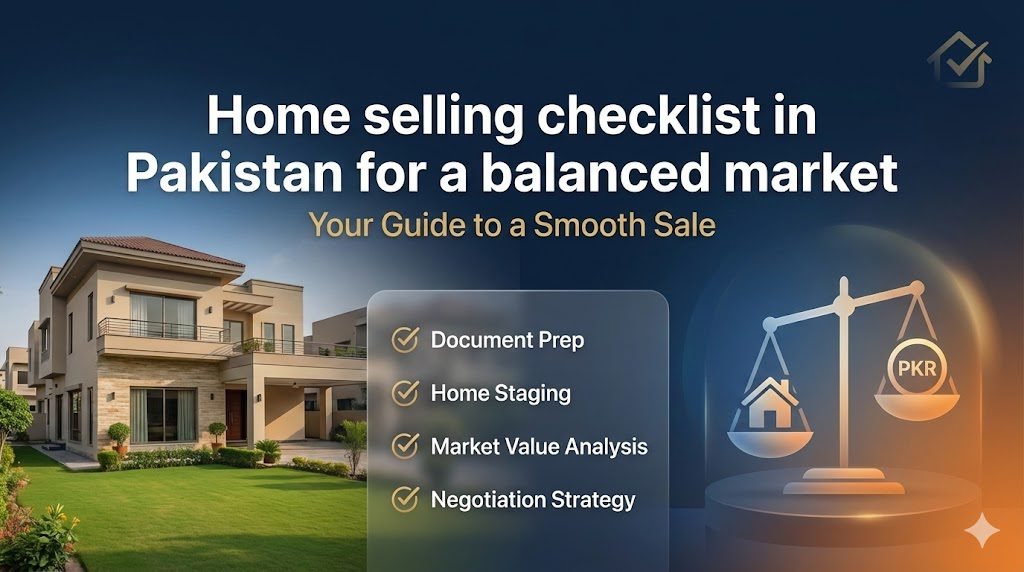
Selling a home in 2026 is not the same playbook many owners used during the peak “seller’s market” years. In Islamabad and Rawalpindi, buyers still show up for the right property, but they negotiate harder, compare more options, and walk away faster if the paperwork or pricing feels off. A home selling checklist in Pakistan helps you control the process: prepare the property, present clean documentation, price with reality, and negotiate without losing time or value.
This article focuses on practical steps that fit Pakistan’s on-ground selling culture (token, bayana, dealers, transfer offices) while keeping it readable for a homeowner, not just an investor. It also stays local to the twin cities—because the selling experience in Islamabad sectors, Bahria/DHA corridors, and Rawalpindi’s developing zones is shaped by approvals, access roads, and transfer procedures.
What a balanced market means for home sellers in Islamabad and Rawalpindi
A balanced market is where supply and demand are closer to equal. Homes still sell, but not every listing sells quickly, and price sensitivity becomes the deciding factor. In this environment:
Buyers behave differently
They shortlist more properties, demand better finishing, ask for more documents upfront, and push for realistic rates. Many prefer “ready-to-transfer” situations to reduce risk.
Negotiation becomes part of the timeline
You should expect counters, revision requests, and buyer conditions (possession timing, minor repairs, payment structure). If you are not prepared, the deal drags or collapses.
Presentation matters more than claims
A clean home, clear photos, and verified paperwork beat loud marketing lines. In a balanced market, trust is a pricing tool.
Step 1: Confirm your selling goal, timeline, and minimum acceptable outcome
Before you touch paint or talk to an agent, define three items:
Your timeline
Decide if you need a quick sale (30–60 days) or you can wait (90–180 days). A longer window gives you stronger negotiating space.
Your minimum acceptable net amount
Do not think only in “selling price.” Think in what you want after:
- Agent/dealer commission (if applicable)
- Transfer and government charges (vary by area)
- Any loan settlement (if the property is financed)
- Minor repairs or touch-ups
Your flexibility points
Write down what you can adjust:
- Possession date
- Partial renovation
- Small negotiation range
- Inclusions (fans, lights, AC units, kitchen appliances)
This prevents emotional decisions when a serious offer arrives.
Step 2: Paperwork readiness checklist (the most common deal-breaker)
In the twin cities, a buyer often decides in two stages: first by location and condition, then by documentation. If documents are unclear, the buyer either lowers the offer or exits.
Ownership and title documents
Depending on the property type and location, assemble:
- Allotment letter / transfer letter (society-based)
- Sale deed / registry papers (where applicable)
- Mutation/intiqal record (where applicable)
- CNIC copies of owners (and any co-owners)
- Proof of paid installments (if on plan)
- Possession letter (if issued)
- Any NOC or society clearance (if required for transfer)
If the property is jointly owned, align signatures and authority early. If someone is abroad, plan a documented authorization route before you list.
Utility and dues clearance
Keep these ready:
- Latest electricity bill (and any arrears cleared)
- Gas bill (if applicable)
- Water/sewerage charges (where applicable)
- Society maintenance dues or service charges (if in a managed community)
Buyers ask for this earlier in a balanced market because they want “zero surprise” after token.
Transfer route clarity (Islamabad vs Rawalpindi)
Islamabad and Rawalpindi can involve different transfer offices and workflows depending on where the property sits (sector, private society, cooperative setup). For Rawalpindi and wider Punjab, mutation and land record processes often align with the Punjab land record system; a helpful official reference for understanding mutation processes is the Punjab Land Records Authority (PLRA) mutation process.
Keep your documents arranged in a single folder (physical + scanned PDF). If a buyer asks for verification, you should be able to share a clean set quickly.
Step 3: Property condition checklist that actually affects price in 2026
In a balanced market, buyers pay for “ready living,” not for “potential.” You do not need luxury renovation—just remove the reasons a buyer negotiates down.
High-impact fixes (low cost, high return)
- Leakage checks: bathroom, kitchen, roof corners
- Electrical basics: switches, sockets, breakers working
- Door locks, handles, latches aligned
- Basic paint touch-up in high-visibility areas
- Clean tiles/grout in bathrooms and kitchen
- Functional water pressure and drainage
Cleanliness and smell control
It sounds small, but it changes offers:
- Deep clean bathrooms and kitchen
- Ventilate closed rooms
- Remove damp smell sources
- Keep balconies and storage areas tidy
Safety and finishing signals
Buyers take these as “maintenance discipline” signs:
- Stair rail stability
- Loose ceiling boards fixed
- Broken window latches repaired
- Proper lighting in key areas
Step 4: Listing presentation checklist (photos, video, and showing flow)
Balanced market buyers use listings as a filter. If your listing looks average, it competes on price alone.
Photos that sell without exaggeration
- Shoot in daylight
- Wide angles, but avoid distortion
- Show: living room, master bed, kitchen, bathrooms, front elevation, parking, staircase, roof (if relevant)
- Add a few shots of the street view or approach road (where safe and appropriate)
A simple video walkthrough
One smooth walkthrough builds trust and reduces “window shopping.” Keep it honest: show both strengths and normal wear, without dramatic edits.
Showing-day preparation
- Turn on lights
- Open curtains
- Put away personal clutter
- Keep a neutral fragrance
- Have a printed one-page sheet ready: size, rooms, location markers, asking price, transfer status, contact
Step 5: Pricing checklist for a balanced market in Islamabad and Rawalpindi
Pricing is where most sellers lose months. Overpricing in 2026 creates a slow listing, repeated low offers, and forced discounting later.
Build your price logic (not a guess)
Use three reference points:
- Recent closed deals in the same area (not only “demand” posts)
- Active listings that are actually getting visits
- Condition adjustment: a renovated home and a worn home do not sell at the same rate even on the same street
Keep your “asking” and “walk-away” separate
- Asking price: room for negotiation
- Target price: what you expect after normal negotiation
- Walk-away: the minimum you accept based on your net goal
Use clean comparables
In Islamabad, a home’s value can shift sharply based on:
- Sector positioning and access
- Parking availability
- Street width and turning ease
- Nearby commercial activity (good or bad)
In Rawalpindi, comparables often move with:
- Main road connectivity
- Development pace around the block
- Transfer ease and dues clarity
If you want a structured way to compare similar listings across the twin cities, the Property AI Cities directory can help you view location clusters and narrow down what “similar” actually means.
Step 6: Marketing checklist that fits 2026 buyer behavior
Avoid noise. Focus on channels that bring serious buyers.
Agent/dealer route
If you choose an agent, define:
- Commission percentage and payment timing
- Whether they can market directly or only bring walk-ins
- Which locations they actively deal in (Islamabad sector specialist vs Rawalpindi society specialist)
Make sure your agent uses your document set correctly. Misstatements create trust issues.
Direct route (owner selling)
If you sell yourself:
- Use clear listing text (size, rooms, location, transfer status)
- Use WhatsApp shareable brochure-style PDF (simple, not flashy)
- Keep a fixed weekly schedule for showings so you do not burn out
Filtering the crowd
Balanced markets bring more “visitors” than “buyers.” Ask politely:
- Are you buying for residence or investment?
- What is your preferred payment mode?
- When do you want possession?
- Have you already arranged financing (if needed)?
You are not rejecting people. You are saving time.
Step 7: Buyer qualification checklist (avoid wasted negotiations)
Many deals in Pakistan fail after token because the buyer’s plan was weak.
Confirm payment capability early
If it’s a cash buyer, confirm timeline and source clarity.
If it’s a financing buyer, confirm:
- Which bank
- Approval stage
- Expected disbursement timeframe
Token and bayana clarity
In local practice, token often signals seriousness, then bayana/earnest money strengthens the agreement. Put everything in writing:
- Amounts
- Dates
- Conditions for refund or forfeiture
- Possession timeline
- Responsibility for transfer charges
One decision-maker rule
If the buyer says “I’ll confirm with my family,” accept it—but treat the deal as pending until the final decision-maker is aligned.
Step 8: Negotiation checklist for a balanced market (where most value is won)
Negotiation is no longer a one-line “final price.” Buyers ask for conditions. Your job is to protect value while giving reasonable comfort.
Common buyer requests in 2026
- Small repair completion before transfer
- A short extension for payment completion
- Inclusion of fixtures (ACs, kitchen hood, geyser)
- Transfer cost sharing
Use trade-offs, not discounts
Instead of cutting price directly:
- Offer quicker possession for a slightly higher price
- Include a fixture instead of reducing cash price
- Offer staged payment dates with written commitment
Keep negotiation documented
Even simple WhatsApp confirmations matter. Summarize decisions after each meeting:
- New offer amount
- Included items
- Proposed timeline
- Next step date
Step 9: Agreement and closing checklist (reduce legal and transfer risk)
This section is the “deal protection” part. In Pakistan, misunderstandings happen because people rely on verbal statements.
Written agreement essentials
Whether your agreement is drafted privately or through professional help, ensure it clearly covers:
- Property identification details
- Total price and payment milestones
- Token/bayana terms
- Possession date and handover condition
- Transfer responsibility and timeline
- What happens if either party delays or backs out
- Signatures of parties and witnesses
Transfer and record update planning
Closing is not just payment; it is also:
- Transfer application preparation
- Dues clearance confirmation
- Scheduling office visits
- CNIC verification readiness
- Any society-required steps (if applicable)
For Rawalpindi and much of Punjab, mutation and record workflow awareness prevents last-minute surprises. The PLRA reference linked earlier is a practical starting point for understanding mutation types and process flow.
Step 10: Final day checklist (handover that prevents disputes)
On the day you complete payment and handover:
Handover items
- Keys (all sets)
- Access cards (if any)
- Utility meter readings noted and photographed
- Copies of paid dues (where relevant)
- Any written confirmation of included items (fixtures/appliances)
Property condition snapshot
Take a short video walk-through at handover time. It protects both parties by showing the condition at the moment of possession.
Post-handover clarity
Confirm who pays:
- Remaining bills after possession date
- Any pending service charges
- Any final transfer follow-ups
A short reality check: what sellers often do wrong in 2026
They list first, then arrange documents
That creates delays at the exact moment the buyer needs confidence.
They price based on one “demand” reference
Markets move street-by-street. A nearby block or a different finishing level can shift pricing.
They negotiate without structure
They agree verbally, then disagreements start when transfer and possession dates approach.
A checklist approach reduces all three problems.
Where Property AI fits in a seller’s workflow (without changing your process)
If you are selling in Islamabad or Rawalpindi and want cleaner comparables and verified location sorting, a neutral approach is to use Property AI once your documents and pricing logic are ready. Platforms like Property AI can help reduce confusion by filtering listings through location and verification signals, especially when buyers compare multiple areas in the same week.
If you want a quick, structured route to validate what buyers ask for (location comparisons, market positioning, basic approval direction), you can use the Property AI Bot as a starting point for organizing questions before you commit to a negotiation path.
FAQs
1) What is the most important part of a home selling checklist in Pakistan?
Document readiness. Clean ownership papers, dues clarity, and a clear transfer route reduce negotiation pressure and lower the chance of deal failure after token.
2) In a balanced market, should I price higher to leave room for negotiation?
You need room, but not a fantasy. If the asking price is far above comparables, serious buyers skip the listing and you attract only low offers. A realistic asking price with planned negotiation space performs better.
3) What should be written clearly before accepting token money?
Payment timeline, refund/forfeit terms, possession date, transfer responsibility, and any included fixtures. Written clarity avoids disputes later.
4) Does a well-maintained home really sell faster in Islamabad and Rawalpindi?
Yes. In a balanced market, buyers compare condition carefully. Small issues like leakage, poor paint, and unclear dues become negotiation points and delay decisions.
5) Which official reference helps understand mutation steps for Rawalpindi property transfers?
For Punjab areas like Rawalpindi, the Punjab Land Records Authority’s mutation information is a practical official reference for process flow and mutation types.
Disclaimer: Information is for awareness, subject to change, and buyers should verify approvals and details independently.