
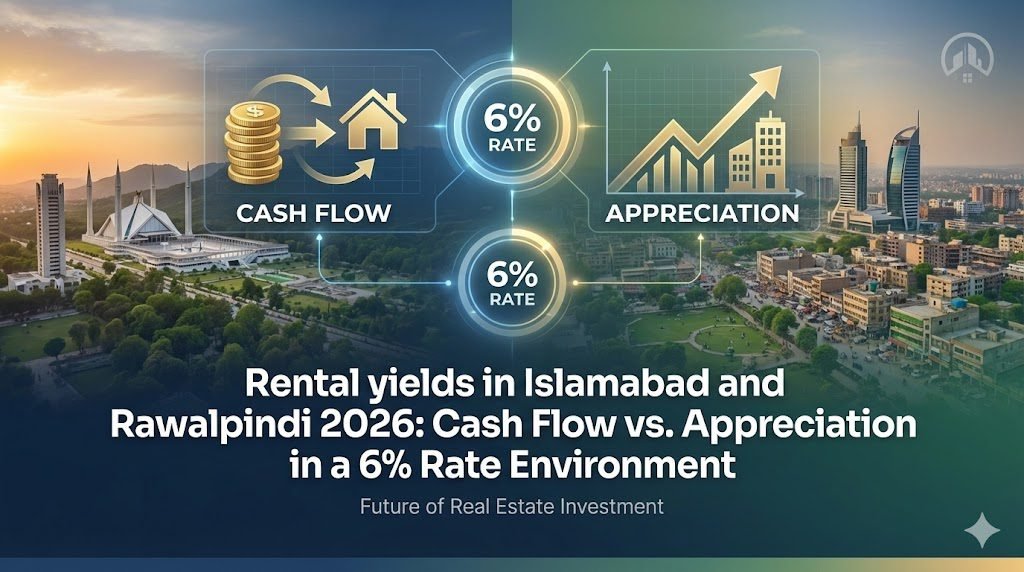
In a market where financing costs and opportunity cost have become harder to ignore, rental yields in Islamabad and Rawalpindi 2026 are no longer a “nice-to-have” metric. They are the filter that decides whether a property is an investment or just a parked asset. A 6% rate environment changes the decision-making math because your expected return is now being compared against a clearer benchmark: if your net rental return cannot compete with that hurdle, you are relying almost entirely on price growth to justify the risk.
Pakistan’s property market still rewards long-term holders, especially in well-known locations across Islamabad and Rawalpindi. But 2026 is a year where the strategy has to be chosen intentionally. Cash flow and appreciation are not the same return engine, and each behaves differently during high-rate cycles, tightening liquidity, and slower resale velocity. This article breaks down the difference, shows where yield tends to be stronger in the twin cities, and explains how to structure a rental-focused plan that remains resilient even when market sentiment cools.
What a 6% rate environment changes for property investors
A “6% rate environment” works as a mental yardstick even if you are not borrowing. It represents what money can earn elsewhere with lower effort and clearer liquidity. That pushes real estate investors to demand more from the income side of the deal.
Here is the practical impact:
- More deals fail at the screening stage. If a property’s realistic net yield sits below the hurdle, it has to offer strong appreciation potential to compete.
- Speculative holding becomes expensive. Vacant units, delayed possession timelines, and under-rented assets feel heavier because the “carry cost” is obvious.
- Buyers pay closer attention to exit liquidity. If resale demand slows, income becomes the stabilizer that keeps the asset rational to hold.
This is why cash-flow-first thinking is back on the table. Not because appreciation is “dead,” but because appreciation becomes harder to depend on when transaction volume drops and buyers become selective.
Cash flow vs. appreciation: two different return engines
Cash flow and appreciation can exist together, but they do not behave the same way.
Cash flow is the return created by rental income after realistic costs. It is measurable and repeatable, but it requires operations: tenant selection, rent collection, maintenance, and vacancy control.
Appreciation is the return created by price movement over time. It can be large, but it is not guaranteed and can be delayed, especially if demand slows or if the project’s delivery timeline stretches.
A disciplined rental strategy starts with the correct yield math:
- Gross Yield = Annual Rent ÷ Purchase Price
- Net Yield = (Annual Rent − Annual Costs) ÷ Purchase Price
Annual costs typically include maintenance, repairs, service charges, vacancy allowance, basic upgrades, agent fees (when relevant), and any property management cost if you are not hands-on.
In a 6% hurdle environment, gross yield can look fine on paper while net yield quietly drops below the line. That is why investors who win on cash flow focus on the “net” number, not the advertised rent.
Rental yields in Islamabad and Rawalpindi 2026: where yield strength usually comes from
The twin cities have a clear pattern: the most premium addresses usually deliver stability and tenant quality, while mid-market, high-demand living zones often provide better yield efficiency.
Islamabad: yield behavior by tenant demand and supply
Islamabad’s rental demand is strongly driven by:
- Government and semi-government employment
- Corporate offices and vendors
- Universities and student populations (in specific pockets)
- Diplomatic and NGO-linked rentals (select zones)
- Short-term and semi-furnished demand near business activity
Yield tends to be influenced by a simple reality: capital values rise faster than rents in the most premium sectors. That compresses yield, even when rents are high. If your plan is income-first, you typically do better by targeting places where tenant demand is strong but price per square foot is still rational.
Income-focused investor behavior in Islamabad usually prioritizes:
- Apartments with consistent occupancy (especially where daily living is easier: access roads, markets, maintenance coverage)
- Portions or smaller units that match the budget of stable salaried tenants
- Areas with predictable rental movement rather than “headline pricing”
Rawalpindi: stronger yield pockets and practical tenant flow
Rawalpindi often presents better yield efficiency because the entry price can be lower while rental demand remains steady due to:
- Dense commercial activity
- Broader middle-income tenant base
- Strong mobility to Islamabad corridors
- Higher preference for practical, service-oriented living
Income-focused investors in Rawalpindi frequently look at:
- Well-connected living zones where commuting to Islamabad is workable
- Units near commercial gravity (markets, employment clusters, transport routes)
- Properties that can be rented without heavy lifestyle positioning
Rawalpindi also tends to respond faster to “value upgrades” (paint, fixtures, basic furnishing, safety improvements) because tenants compare utility and comfort more than branding.
Property type decisions: what usually supports cash flow better
Apartments: efficient for yield, stronger for occupancy management
Apartments often support better operational control:
- Easier maintenance coordination
- Predictable service charge structure (even if it reduces net yield, it increases stability)
- Higher tenant turnover but faster re-leasing in active buildings
Apartments work well for rental yield plans when the building has decent management, reliable utilities, and a tenant pool that renews leases.
Portions: good income potential, but operations matter more
Portions can produce strong rent relative to price if:
- Entry pricing is not inflated
- Parking, utilities, and access are practical
- Landlord-tenant boundaries are clear (especially in shared houses)
Portions can also create friction if utility split, privacy issues, or owner interference becomes a tenant complaint.
Houses: stable tenant profile, but yield can be weaker
Houses often provide stability and longer tenancies, but yield may compress because:
- Purchase price is higher relative to achievable rent
- Maintenance and repairs can be heavier
- Tenant pool for higher-rent houses is smaller
If a house is chosen for yield, it usually needs either (a) multi-portion rent strategy, or (b) a location where corporate/family demand is consistently present.
Small commercial units: higher rent potential, higher risk profile
Commercial units can produce higher yields, but the risk is different:
- Vacancy periods can be longer
- Tenant churn can be disruptive
- Market cycles and footfall matter a lot
- Legal/usage compliance needs careful verification
For cash-flow strategy, commercial works best when there is proven demand and existing operational activity—not only a future promise.
Building a rental yield plan that clears a 6% hurdle
The goal is not to force every property into the same model. The goal is to create a repeatable approach that makes net yield predictable.
1) Start with a rent reality check, not an asking-rent fantasy
Many listings quote “ideal rent,” not “signed rent.” A better method is to compare:
- Current leased units in the same building/row
- Tenant profile and furnishing level
- Maintenance level and utility reliability
A rent plan should be built from what tenants actually accept, not what owners hope for.
2) Design for the tenant who renews
Renewals are where cash flow becomes smooth. Renewals improve net yield because they reduce:
- Vacancy gaps
- Agent fees
- Refresh costs
- Time spent on viewings and negotiations
This means the unit should be positioned for a tenant type with stable income and stable stay duration.
3) Make “net yield protection” a habit
Net yield is protected by managing leakage:
- Set a vacancy allowance in your numbers even if the unit is currently occupied
- Budget annual repairs and planned upgrades
- Treat service charges and utilities as real costs, not “small extras”
- Avoid over-renovation that cannot be priced into rent
A unit that looks cheaper but bleeds cash can underperform a “slightly higher priced” unit that stays consistently occupied.
4) Use furnishing as a yield tool, not as decoration
Furnishing can lift rent, but it should be chosen based on tenant demand:
- Semi-furnished often works better than fully furnished for stable families
- Fully furnished can work better near business districts, consulting-based tenants, and short-term corporate needs
- Durable, simple furnishing wins over luxury furnishing because replacement cycles destroy net yield
5) Use a clear decision rule: income deal or appreciation deal
To avoid mixed strategy confusion, label each purchase:
- Income deal: must clear the 6% hurdle on net yield with normal assumptions
- Appreciation deal: may accept lower yield, but only with a clear catalyst (infrastructure delivery, possession timeline, verified development progress, and resale liquidity)
If a deal is weak on both income and appreciation logic, it is usually not a deal—it is a story.
Where appreciation still makes sense in a high-rate market
Appreciation is still valid in Pakistan, especially when the investment is aligned with real delivery progress and verified legal standing. Appreciation makes more sense when:
- Infrastructure delivery is visible and consistent
- Possession reality is clear
- Utility readiness is improving
- End-user demand exists (not only investor flipping)
A high-rate cycle often slows speculative flipping, but it can support appreciation in areas where end-users are steadily moving in because the place is livable.
This is also where verification becomes non-negotiable. Approvals, zoning reality, and on-ground status are the difference between a patient investment and a stuck file.
For buyers comparing verified investment options across the twin cities, the listings and area context on Property AI can help narrow search based on location logic rather than marketing noise.
A short due diligence checklist for yield-focused buying
A yield-focused purchase is decided by what you can validate:
- Signed rent evidence (or strong comparables, not only asking rents)
- Vacancy behavior in the building/area (fast re-leasing matters)
- Service charge structure and what it actually covers
- Utility reliability (power backup, water availability, maintenance response time)
- Legal clarity (ownership documentation, transfer feasibility, building compliance)
- Tenant demand driver (jobs, universities, offices, markets, transport access)
When numbers are close to the hurdle, discipline matters more than optimism. Small mistakes in vacancy or maintenance assumptions can push net yield below the line.
A practical approach for 2026: blend strategy, not guesswork
In 2026, the strongest approach for most investors in Islamabad and Rawalpindi is a blended plan:
- Keep one portion of your exposure in stable, rent-driven assets that protect downside
- Keep a smaller portion in appreciation-driven assets, but only where approvals and delivery timeline are verifiable
- Avoid buying something that depends on both perfect rent and perfect resale
If you want to sanity-check approvals, location logic, and risk flags while shortlisting options, Property AI Bot can help structure your questions so you are comparing facts instead of hype.
FAQs
What is a reasonable rental yield target in a 6% rate environment in Pakistan?
A common approach is to target a net yield that can compete with the 6% hurdle after vacancy and maintenance assumptions. If net yield is below that line, the investment should have a clear and verifiable appreciation catalyst, not just a timeline promise.
Which performs better for stable rent in the twin cities: apartment, portion, or house?
Apartments often provide smoother occupancy management, portions can provide strong rent-to-price efficiency when utilities and privacy are well-managed, and houses tend to offer longer tenancies but may compress yield due to higher entry cost.
Is rental income taxed in Pakistan?
Rental income is generally part of taxable income under Pakistan’s tax framework. Investors should factor compliance and documentation into their net yield planning and confirm their position with updated rules and professional advice.
Can overseas Pakistanis manage rental property in Islamabad and Rawalpindi without being present?
Yes, but the performance depends on tenant screening, documentation discipline, and reliable on-ground management. A remote plan works best when maintenance response time and rent collection process are clearly structured.
What should be verified before buying a property primarily for rental yield?
Key checks include ownership documentation, transfer feasibility, realistic rent comparables, building/service charge details, utility reliability, and any approvals or usage compliance relevant to the property type.
Disclaimer: Information is for awareness, subject to change, and buyers should verify approvals and details independently.