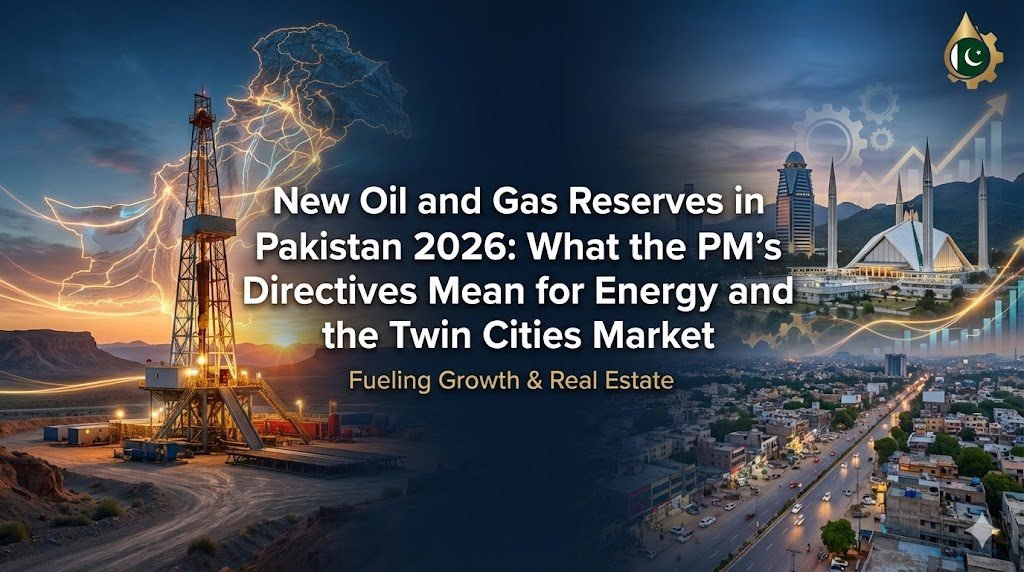
Pakistan’s energy picture is entering 2026 with two things happening at the same time: fresh upstream momentum and stronger pressure on the system to perform. The headline that matters is new oil and gas reserves in Pakistan 2026, driven by a verified discovery in Khyber Pakhtunkhwa and a federal push to tighten the entire petroleum value chain. For households and investors in Islamabad and Rawalpindi, this is not only an “oil story.” Fuel availability, gas network reliability, transport costs, and industrial activity all flow into property demand, construction costs, and the pace of on-ground development.
This article breaks down what was officially announced, what the discovery actually means in operational terms, and which indicators should be tracked during 2026 if you care about energy stability and its knock-on impact on the Islamabad–Rawalpindi corridor.
What was announced in early 2026, and why it matters
In early January 2026, a high-level meeting chaired by the Prime Minister focused on two themes: accelerating domestic supply and closing leakages in the downstream supply chain. The messaging was direct: increase indigenous production where possible, curb smuggling and theft, and digitise tracking so that volumes can be audited from import and refinery stages through storage and retail distribution.
For consumers, the practical reason this matters is simple. When energy is scarce or poorly tracked, shortages and price distortions spread through transport, manufacturing, and building activity. In Pakistan, where logistics costs can materially influence cement, steel, and finishing material prices, even small improvements in supply reliability can show up in construction timelines and household budgets.
The verified discovery behind the headlines: Baragzai X-01 in Nashpa Block
The most concrete “reserves” update tied to this news cycle is an official disclosure by Oil and Gas Development Company Limited (OGDCL) about an exploration success in Nashpa Block (District Kohat, Khyber Pakhtunkhwa). OGDCL, as operator with 65% working interest, reported that the exploratory well Baragzai X-01 (Slant) tested in the Datta Formation and flowed at 4,100 barrels of oil per day and 10.5 MMSCFD of gas during a cased-hole drill stem test. The disclosure also confirms joint venture partners PPL (30%) and GHPL (5% carried interest).
Two important clarifications for readers:
Reserve additions vs “immediate nationwide relief”
A test rate is not the same thing as instant nationwide price relief. Production must be integrated into gathering systems, processing capacity, and commercial allocation. Still, verified discoveries matter because they add incremental domestic supply and strengthen the reserves base that supports future field development.
Why Datta Formation matters in Pakistan’s upstream context
Datta is a known petroleum system horizon in parts of Pakistan. A flowing test in Datta, plus the note that earlier testing in Kingriali Formation was also successful at the same well, signals multi-zone potential in the block.
What “strong action” looks like in the petroleum supply chain
A second pillar of the 2026 messaging is enforcement and digitisation. The meeting referenced the objective of reducing smuggling and theft by tracking movement of petroleum products and tightening compliance.
In Pakistan’s context, “strong action” generally translates into four practical levers:
1) Digitised product movement and reconciliation
When supply is traceable, mismatches between refinery outflow, depot receipts, and retail sales become easier to flag. Over time, tighter reconciliation reduces grey-market diversion and helps stabilise availability in legitimate channels.
2) Tightened monitoring at storage and retail nodes
Leakage is rarely only at borders. Storage depots, transport routes, and retail practices can distort volumes. Better monitoring is operationally boring but economically meaningful.
3) Faster response to shortfalls in high-demand corridors
Islamabad and Rawalpindi sit at a high-traffic junction of national mobility. Supply shocks typically reflect quickly here—through transport fares, delivery delays, and business operating costs. Enforcement that keeps legal supply moving reduces secondary inflation pressure.
4) Better commercial confidence for large infrastructure builds
Developers and contractors price risk. If fuel and energy disruptions become less frequent, contractors can plan more confidently, which can reduce schedule slippage.
Gas network updates that link directly to Islamabad and Rawalpindi
Beyond the discovery itself, the meeting also highlighted gas network expansion and infrastructure work with a specific target: reaching 350,000 RLNG connections by June 2026.
For the Islamabad–Rawalpindi market, gas network changes are highly relevant because they influence:
- household operating costs and winter load pressure
- commercial kitchen and hospitality operating reliability
- small industrial demand in and around Rawalpindi’s mixed-use zones
- feasibility of certain density patterns in newer extensions and peri-urban corridors
The same update referenced commissioning pipelines from the Sheva and Batani gas fields, and noted work on the Kot Palak pipeline.
Even without turning this into a technical briefing, the core point is that incremental field tie-ins and pipeline additions reduce pressure on the most constrained parts of the network—especially in peak seasons.
What this means for construction and property markets in the Twin Cities
Energy developments do not change property values overnight, but they influence the inputs that shape demand and supply. In Islamabad and Rawalpindi, the relationship is usually visible through five channels:
1) Construction cost stability
Fuel costs and supply disruptions influence transport of bulk materials (cement, sand, crush, steel) and finishing supplies. If supply chain management improves and disruptions reduce, contractors face fewer stop-start cycles, which helps project delivery discipline.
2) Industrial and logistics activity around major roads
The Twin Cities’ growth is tied to connectivity corridors—Islamabad Expressway, IJP Road, GT Road access points, and motorway-linked routes feeding Rawalpindi’s commercial belts. When energy and fuel supply are less erratic, logistics and light industry operate with fewer interruptions, supporting job clusters and rental demand.
3) Apartment and mixed-use demand sensitivity
In 2026, affordability pressure already pushes many households toward vertical living and mixed-use convenience. Energy reliability (gas and electricity load patterns) becomes part of buyer decision-making, especially for families comparing older central sectors vs newer extensions.
4) Development pace in peri-urban projects
Many outer projects sell faster than they develop. When energy-driven inflation spikes, development budgets stretch and timelines slip. Anything that marginally improves the macro operating environment can support steadier on-ground progress.
5) Buyer behaviour: more verification, less brochure trust
One consistent shift in Pakistan’s market is that buyers increasingly ask: What is delivered on ground, what approvals exist, and what is the utility plan? Energy headlines reinforce that mindset. The right approach in 2026 is to validate development reality rather than rely on marketing narratives.
Practical indicators to track during 2026
If you want to judge whether this 2026 push is translating into measurable change, watch these indicators instead of headlines:
Upstream follow-through on the Nashpa discovery
A single disclosure is a starting point. Watch for:
- tie-in progress and sustained production reporting
- additional appraisal or development activity in Nashpa Block
- multi-zone completion decisions, given the testing notes.
RLNG connection rollout pace through June 2026
The stated target is large enough that progress should be visible in official and utility-side rollout metrics.
Evidence of reduced supply leakage
You may not see full public dashboards, but signs can include fewer shortage episodes, fewer abrupt supply gaps in legitimate channels, and better consistency in availability during peak travel windows.
Pipeline and field tie-in operational outcomes
Commissioning announcements matter less than stable throughput. The market impact comes when the system runs reliably during demand spikes.
Where Property AI fits in this topic, without hype
Energy reliability shapes where people choose to live and where businesses choose to expand, especially across Islamabad and Rawalpindi. For readers comparing projects across multiple zones, Property AI Cities can help organise searches by location while keeping the focus on practical decision factors like access corridors, development reality, and day-to-day livability.
If you prefer a guided shortlist based on your budget and preferred areas in the Twin Cities, the Property AI Bot can support a structured comparison approach rather than brochure-based decision-making.
Conclusion
The phrase “new reserves” can be misused in Pakistan’s market, so it is worth anchoring 2026 in verified facts. The Baragzai X-01 test in Nashpa Block is a documented discovery with reported flow rates and confirmed JV structure, which strengthens the domestic reserves base. At the same time, the federal emphasis on digitisation, enforcement, and network expansion—alongside targets like RLNG connections through June 2026—signals a governance push aimed at reducing leakage and improving reliability.
For Islamabad and Rawalpindi, the value of this story is not a promise of instant cheaper fuel. It is the possibility of fewer disruptions, steadier logistics, and better predictability for businesses and construction activity. In a market where predictability is a real premium, that is the part to watch through 2026.
FAQs
1) What do the new oil and gas reserves in Pakistan 2026 actually refer to?
They refer to verified discoveries and reserve additions reported by operators, such as OGDCL’s disclosure of the Baragzai X-01 discovery in Nashpa Block, along with broader policy focus on improving supply reliability.
2) Where is the Baragzai X-01 discovery located and what were the reported test rates?
The well is located in District Kohat, Khyber Pakhtunkhwa (Nashpa Block). OGDCL reported a test flow of 4,100 BOPD and 10.5 MMSCFD of gas in Datta Formation during DST-02.
3) Will this discovery reduce petrol prices in Islamabad and Rawalpindi in 2026?
A single discovery does not automatically reduce retail prices. The impact depends on sustained production, integration into supply systems, and broader pricing and import conditions.
4) What 2026 indicators matter most for gas reliability in the Twin Cities?
Track progress toward RLNG connection targets and whether pipeline commissioning translates into stable throughput during peak demand months.
5) Why do energy updates matter for property buyers in Islamabad and Rawalpindi?
Energy and fuel reliability influence construction costs, delivery timelines, transport and business operating costs, and rental demand near active commercial and logistics corridors.
Disclaimer: Information is for awareness purposes only and is subject to change. Buyers should verify approvals and details independently.