If you’re searching “Is Blue World City approved”, you’re not alone. In Pakistan’s property market, approvals can vary by authority, area, and even block/extension, and the same project can appear in different regulatory updates over time. This is exactly why buyers in Islamabad and Rawalpindi should treat “approved” as a verifiable status—not a marketing claim.
This blog answers the core questions people ask before booking:
- Who is the owner of Blue World City?
- What is DHA-style “authority control” vs private developer control?
- What does “approved” mean in Rawalpindi’s regulatory environment?
- What are the developer payment-plan prices for 5 Marla and 8 Marla (and what those numbers actually represent)?
- Where exactly is Blue World City, and what routes matter for Islamabad/Rawalpindi buyers?
What “approved” means in Rawalpindi and Islamabad market reality
In the twin cities, approvals usually revolve around:
- Who has jurisdiction over the land (RDA area, District Council area, or other oversight)
- Whether the project has planning permission, layout approval, and/or an NOC
- Whether approvals apply to the entire scheme or only specific land, phases, or blocks
- Whether the authority has issued warnings, notices, or legal actions regarding marketing or expansion
That’s why the same project can be discussed in different ways at different times. A buyer should treat “approved” as a question that requires a current check from the regulator, not an assumption based on old PDFs, old social posts, or dealer claims.
For the Rawalpindi side, the most direct official starting point for verification is the regulator’s own housing-schemes portal: Rawalpindi Development Authority’s private housing schemes portal.
Is Blue World City approved?
The most accurate way to answer “Is Blue World City approved” is:
- Approval status must be verified on the regulator’s official listings, and
- Verification should be done for the exact block/sector/extension you are being offered, not only the project name.
In practical terms, when you are offered a “file,” “plot,” or “balloted plot,” ask for:
- The exact block/sector name (General Block Sector/Phase, Overseas, Sports Valley, Waterfront, Legends Enclave, etc.)
- The land/area reference used in documentation
- The type of approval being claimed (planning permission, layout approval, NOC, district council approval, etc.)
- The latest official evidence that matches the specific product you’re buying (not a generic approval claim)
This approach protects you from one common problem in Pakistan: buyers being shown an approval reference that applies to one area, while being sold a different area.
Who is the owner of Blue World City?
In most public documentation and project positioning, Blue World City is linked with:
- Blue Group of Companies (BGC) as the primary private developer identity, and
- A development collaboration narrative (often described as a Pakistan–China oriented concept in branding)
When people ask “owner,” they usually mean: who controls the project and who is accountable for delivery and documentation? In market practice, accountability sits with the project developer/sponsors operating under the developer group identity and the project’s official management.
A clean way to treat this as a buyer: don’t rely on hearsay. Use owner/sponsor names only as supporting context, and treat the approval trail and payment receipts in the developer’s designated accounts as the practical proof points that matter.
What is Blue World City in Pakistan?
Blue World City is marketed as a large-scale housing project positioned near the twin cities corridor, pitched to:
- End users who want a planned society lifestyle near Islamabad/Rawalpindi
- Investors who prioritize installment-based entry into a project narrative (tourism, economic zone, themed blocks)
- Overseas Pakistanis (through block branding and overseas-oriented inventory)
From a buyer perspective, the correct way to view it is not “a single product.” It’s a cluster of blocks and offerings (residential plots, commercial plots, sometimes villas/apartments) where each offering can have its own:
- documentation style (file vs plot vs balloted plot),
- development timeline,
- and verification requirements.
Blue World City location guide for Islamabad and Rawalpindi buyers
People often say “Blue World City Islamabad,” but the location logic is best understood through routes and landmarks, because that’s what affects usability and resale behavior.
The corridor that matters
Blue World City is generally associated with the Chakri Road / M-2 corridor, a zone that matters because it connects:
- Islamabad side travel patterns (airport axis and motorway access)
- Rawalpindi side travel patterns (Ring Road behavior and outward expansion)
Common access points used by buyers
When you evaluate location in the twin cities, ask one simple question: What is the route I’ll actually use weekly?
Typical route thinking looks like this:
- From Islamabad (airport/expressway side): buyers often think in terms of reaching the motorway corridor quickly and then moving outward
- From Rawalpindi: buyers evaluate whether the approach is easier via outward roads and whether future linkages reduce travel friction
What to verify on-ground (location checklist)
Instead of relying on map pins alone, verify:
- Main approach road condition (daytime + evening)
- Signage quality and continuity from a major road
- Whether the “shortcut route” claimed by dealers is actually usable year-round
- Whether the block you’re being sold has on-ground demarcation and accessible internal tracks/roads
Location in Pakistan isn’t only distance. It’s predictable travel time and repeatable access, especially for families and for buyers comparing multiple societies around Islamabad/Rawalpindi.
What is the price of plots in Blue World City?
This question needs a careful answer because “price” can mean two different things:
1) Developer payment plan price (registration cost / total price in a schedule)
This is the amount shown on a payment plan (down payment + installments + sometimes separate charges). It represents what the developer is offering at that time under that plan.
2) Market resale price (dealer-to-buyer rate)
This is what you might pay in the secondary market for a file/plot. It can be higher or lower depending on:
- balloting status,
- development progress,
- documentation confidence,
- and buyer demand for that specific block.
When you ask “price,” clarify which one you mean. Most people starting out actually need the developer plan price first—because that’s the baseline for affordability.
How much is 5 Marla in Blue World City?
For 5 Marla, one widely circulated developer-style schedule for General Block (Sector 1) shows a total registration cost of PKR 1,490,000 for 125 sq. yd (5 Marla). In practical buyer terms:
- Treat this as a payment-plan baseline tied to that specific schedule and sector reference.
- Confirm whether your booking is Sector 1, Sector 2, Phase 2, or another product label, because pricing structures can change by inventory and time.
Also remember: even in developer plans, some amounts may be listed as separate heads (confirmation, down payment, installments, possession/development charges). Always calculate your total payable from the exact schedule you are signing.
How much is 8 Marla plot in Blue World City Islamabad?
8 Marla pricing depends heavily on which block you’re booking.
One official developer payment plan document for Legends Enclave (a Blue World City-linked offering) lists the 8 Marla total price as PKR 5,400,000 under a 4-year registration-style schedule (with development charges included in that plan’s wording).
For buyers, the key takeaway is not only the number. It’s the context:
- Is the offered 8 Marla in a block where 8 Marla is a standard inventory size?
- Is it a file-based registration or an on-ground plot tied to balloting/possession?
- Which charges are included in the total, and which are separate?
If a dealer quotes a much lower 8 Marla price, ask whether they are quoting General Block-style baseline pricing (where 8 Marla might not even be the standard size), or whether they’re quoting a different product altogether.
Is Blue World City approved by RDA, District Council, or another authority?
Buyers in Rawalpindi/Islamabad should stop thinking of approvals as a single stamp. A safer approach is:
- Identify the authority relevant to your block/area
- Match the exact scheme/block name to what the authority lists
- Confirm that the project is not only “in process” or “partial,” if your risk appetite is low
This matters because:
- A project can have planning permission for a portion of land
- Another part can be under process
- An expansion can be questioned
- And marketing claims can stay ahead of approvals
That’s why the verification step using the regulator’s portal is non-negotiable when you’re treating this as a serious purchase.
What is Blue World City good for?
This is where buyer behavior in Pakistan becomes important. Blue World City is typically considered for:
End-user families
- People who want an installment entry point and hope for mid-term livability
- Families who prioritize “society lifestyle” framing and future facilities
Investors
- Buyers looking for a long-hold position in an outward expansion corridor
- Buyers who plan to exit after a development milestone (balloting, possession, road works)
A practical note for Islamabad and Rawalpindi: investment outcomes are usually tied to documentation confidence + actual on-ground progress, not only marketing themes.
A safer way to compare options in Islamabad and Rawalpindi
Most buyers compare Blue World City with other installment projects in the corridor. The comparison gets messy because every seller uses different claims.
A cleaner method is to compare only on:
- Verified approval status for the exact block
- Clear payment-plan math (total payable, timeline, penalties)
- Development evidence you can see
- Access routes you will actually use
For buyers comparing verified projects across Islamabad and Rawalpindi, platforms like Property AI city listings help organize options by location and decision intent without relying on dealer narratives.
Featured image idea (for blog)
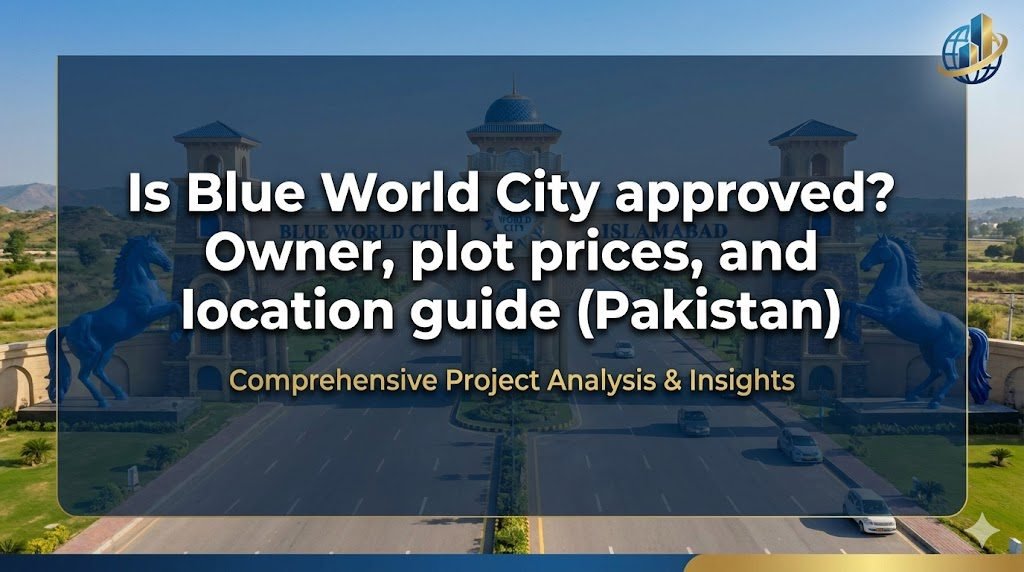
Image description: A daylight aerial-style visual of the Chakri Road–M-2 corridor with Islamabad/Rawalpindi directional markers and a clean map-style overlay.
Alt text (SEO): Is Blue World City approved – location corridor map for Islamabad and Rawalpindi buyers
FAQs
Is Blue World City approved?
The safest answer is: verify the current status for the exact block/sector on the regulator’s official housing-schemes listings, because approval status can vary by area and time.
Who is the owner of Blue World City?
Blue World City is associated with the Blue Group of Companies and project sponsors/management under the project’s official developer identity. For purchase safety, focus more on verified approvals and official receipts than on name-only claims.
How much is 5 Marla in Blue World City?
A commonly circulated General Block (Sector 1) schedule lists a 5 Marla total registration cost of PKR 1,490,000. Treat this as a plan-specific baseline and confirm the exact sector/block and the latest schedule before booking.
How much is 8 Marla plot in Blue World City Islamabad?
8 Marla price depends on the block. An official Legends Enclave payment plan lists the 8 Marla total price as PKR 5,400,000 under its stated schedule terms. Always confirm the block and whether any charges are separate.
Where is Blue World City located?
It is generally associated with the Chakri Road / M-2 corridor near the Islamabad–Rawalpindi region. For a practical decision, verify the route you’ll use weekly and confirm on-ground access to the specific block you are buying.
Disclaimer: Information is for awareness and may change. Buyers should verify approvals, documentation, and current payment plans independently before any booking or transfer.