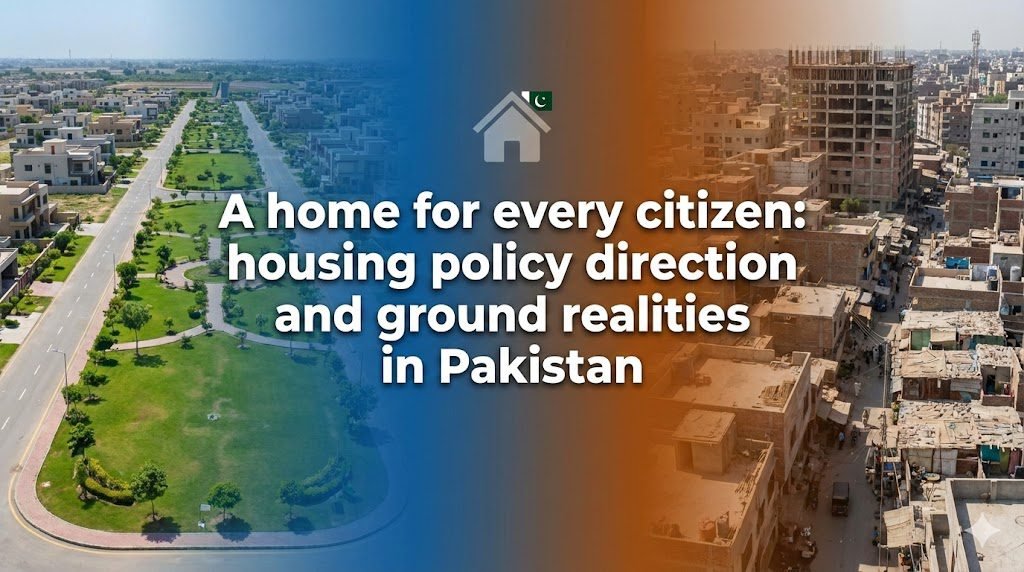
The phrase A home for every citizen represents one of Pakistan’s most ambitious social and economic objectives. Housing is not only about shelter; it directly connects to dignity, stability, health, employment, and long-term national development. In Pakistan, where rapid urbanization, population growth, and affordability gaps continue to widen, the promise of universal housing carries both urgency and complexity.
This discussion is not about slogans. It is about understanding what “a home for every citizen” practically means within Pakistan’s legal, financial, and planning framework—especially in cities like Islamabad and Rawalpindi, where demand consistently outpaces supply.
Why housing remains a national challenge in Pakistan
Pakistan has faced a housing shortfall for decades. Multiple structural factors contribute to this gap:
- Rapid population growth
- Rural-to-urban migration
- Rising land and construction costs
- Limited access to affordable financing
- Fragmented urban planning
Urban centers absorb the highest pressure. Islamabad attracts government employees, private-sector professionals, and overseas Pakistanis. Rawalpindi, as its twin city, absorbs spillover demand due to relatively lower prices and wider land availability.
The result is a market where formal housing struggles to keep up with real demand.
Understanding “A home for every citizen” in policy terms
When governments speak of A home for every citizen, the objective usually includes:
- Expanding affordable housing supply
- Supporting low- and middle-income households
- Encouraging private-sector participation
- Regulating speculative practices
- Improving access to mortgage finance
This vision depends heavily on execution. Policy intent alone does not translate into housing units unless supported by land availability, approvals, financing mechanisms, and market discipline.
Islamabad and Rawalpindi: pressure points in the housing system
Islamabad’s planned sectors offer structured living but limited expansion capacity. Land scarcity and high development standards make affordability a persistent challenge.
Rawalpindi plays a complementary role:
- Larger peripheral land banks
- Mixed private and public developments
- Wider range of price points
However, both cities face similar issues:
- Approval delays
- Infrastructure alignment
- Informal development pressure
Any serious housing-for-all strategy must address these twin-city dynamics together rather than in isolation.
Role of approval authorities and regulation
Housing delivery depends on regulatory clarity. In the Islamabad–Rawalpindi region, multiple authorities influence housing outcomes:
- Capital Development Authority (Islamabad)
- Rawalpindi Development Authority
- Punjab Housing and Town Planning Agency
Approval delays, unclear zoning, and inconsistent enforcement raise costs and slow delivery. When legal supply slows, informal or semi-formal developments fill the gap, increasing long-term risk for buyers.
For official context on planning and housing regulation in the federal capital, reference information published by the Capital Development Authority (CDA) through its official website.
Affordability versus availability
A critical misconception in housing debates is equating availability with affordability. Pakistan has housing stock, but much of it is priced beyond the reach of average-income households.
Key affordability barriers include:
- High upfront payments
- Short installment tenures
- Limited long-term mortgage penetration
- Rising construction material costs
Unless financing structures improve, increasing supply alone will not achieve the goal of housing for all.
Financing as the backbone of housing access
Mortgage access in Pakistan remains limited compared to regional benchmarks. Without accessible financing:
- Middle-income families delay ownership
- Informal settlements expand
- Rental pressure intensifies
Sustainable housing solutions require:
- Longer loan tenures
- Predictable interest frameworks
- Clear property title systems
Financing and legality move together. Banks lend against documented, approved properties, not informal claims.
Private sector’s role in housing delivery
The private sector delivers the majority of housing units in Pakistan. Developers respond to incentives, risk profiles, and regulatory clarity.
When policies encourage:
- Transparent approvals
- Infrastructure coordination
- Predictable development timelines
Private developers are more likely to invest in mid-income and affordable segments. When uncertainty dominates, focus shifts toward premium or speculative projects.
Infrastructure linkage and livability
A home is not just a structure. Livability depends on:
- Road access
- Water supply
- Sewerage
- Schools and healthcare
- Public transport
Housing schemes disconnected from infrastructure shift costs onto residents and local governments. A realistic housing-for-all approach integrates residential planning with transport and utility development.
Urban sprawl versus planned density
Uncontrolled sprawl raises service costs and reduces quality of life. Planned density—especially around transport corridors—supports affordability by reducing per-unit infrastructure cost.
Islamabad’s planning framework historically favored controlled density. Rawalpindi’s growth has been more organic. Balancing these models is central to future housing outcomes.
Social housing and targeted support
Universal housing does not mean identical housing. Different income groups require different approaches:
- Subsidized housing for low-income households
- Rent-to-own models for middle-income groups
- Market-driven options for higher-income buyers
Targeted support reduces fiscal strain while addressing real needs.
Data-driven decision-making in housing
One challenge buyers face is fragmented information. Lack of reliable data leads to:
- Misinformed purchases
- Speculation-driven pricing
- Increased legal disputes
Structured data platforms help buyers compare locations, approval status, and development context more objectively.
For users comparing verified property options across Islamabad and Rawalpindi with a focus on clarity rather than marketing, Property AI supports organized property searches based on real location and listing data.
Avoiding speculation-driven distortions
Speculative buying inflates prices without adding housing units. When policy incentives favor holding over building, affordability suffers.
Measures that discourage excessive speculation include:
- Transparent transaction records
- Timely development requirements
- Better tax documentation
Housing policy must balance investment with actual occupancy.
Lessons from past housing initiatives
Pakistan has launched multiple housing initiatives over the years. Common lessons include:
- Execution matters more than announcements
- Coordination between agencies is essential
- Financing frameworks determine uptake
Programs that aligned approvals, financing, and infrastructure performed better than isolated schemes.
What citizens should realistically expect
Citizens should understand that A home for every citizen is a long-term structural goal, not a short-term guarantee. Progress appears through:
- Incremental supply increases
- Improved financing access
- Better regulatory transparency
Managing expectations helps maintain trust while allowing gradual reform.
Implications for future urban growth
Housing policy shapes cities for generations. Decisions made today affect:
- Traffic patterns
- Environmental sustainability
- Social cohesion
A balanced approach ensures that future growth remains inclusive rather than exclusionary.
The importance of verification in housing choices
Regardless of policy direction, individual buyers remain responsible for verification:
- Approval status
- Development timelines
- Legal transfer mechanisms
No policy can protect buyers who rely solely on informal assurances.
FAQs
What does “A home for every citizen” mean in Pakistan?
It refers to expanding access to affordable, legal housing through policy, private-sector participation, and financing support.
Is housing shortage only an urban issue?
No. Rural housing faces quality and infrastructure challenges, while urban areas face affordability and density pressure.
Why is housing expensive in Islamabad?
Limited land supply, high development standards, and strong demand contribute to higher prices.
Can Rawalpindi absorb Islamabad’s housing demand?
To some extent, yes, but only with proper planning, infrastructure, and regulation.
How can buyers reduce risk when purchasing property?
By verifying approvals, understanding financing terms, and avoiding undocumented transactions.
Disclaimer
This information is for awareness only and is subject to change. Housing policies, approvals, and development conditions may evolve, and buyers should independently verify all legal and regulatory details before making property-related decisions.