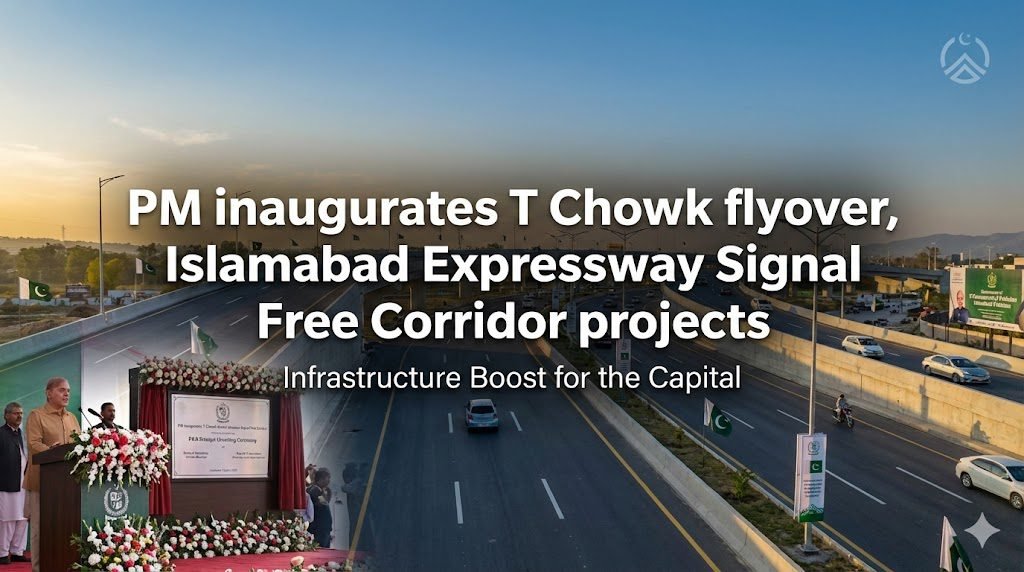
The PM inaugurates T Chowk flyover and Islamabad Expressway signal free corridor projects milestone marks a major shift in how Islamabad manages traffic flow, commuter safety, and urban connectivity. These infrastructure upgrades are not cosmetic additions; they directly change how people move between Rawalpindi and Islamabad, reduce daily congestion, and influence property demand along major road arteries. For residents, businesses, and investors, the operational impact of these projects matters more than the inauguration ceremony itself.
Islamabad Expressway is one of the most critical north–south corridors in the twin cities. For years, choke points such as T Chowk disrupted traffic, increased commute times, and created safety concerns. With the flyover and signal free corridor now operational, Islamabad’s transport spine has entered a new phase focused on uninterrupted flow and capacity handling rather than temporary traffic management.
Strategic importance of the Islamabad Expressway corridor
Islamabad Expressway links key urban and peri-urban zones, connecting Rawalpindi’s dense residential areas with Islamabad’s sectors, employment hubs, and institutional districts. It serves daily commuters, freight movement, public transport, and emergency services.
Before the signal free initiative, repeated traffic signals caused:
- Long peak-hour delays
- Higher fuel consumption
- Increased accident risk
- Uneven load on alternative routes
The transformation of this corridor into a signal free stretch improves average travel speed and reduces stop-start congestion, which has measurable economic and environmental benefits.
T Chowk flyover: resolving a long-standing bottleneck
T Chowk has historically been one of the most problematic intersections on Islamabad Expressway. Traffic merging from multiple directions, combined with signal-based control, created daily gridlock.
The flyover resolves this by:
- Separating through-traffic from intersecting flows
- Allowing uninterrupted movement on the main expressway
- Reducing conflict points that previously caused accidents
From an urban planning perspective, grade separation at high-volume junctions is a proven method to stabilize traffic patterns. The T Chowk flyover aligns Islamabad with that approach, especially as traffic volumes continue to rise.
Signal free corridor concept and its execution
A signal free corridor is not merely about removing traffic lights. It requires:
- Properly designed interchanges
- Managed access points
- Controlled U-turns
- Pedestrian safety solutions
On Islamabad Expressway, this approach ensures that traffic maintains a steady flow rather than cycling between acceleration and braking. The result is smoother movement across longer distances, particularly for intercity commuters traveling between Rawalpindi and Islamabad.
Impact on daily commuters
For daily commuters, the benefits are immediate and practical:
- Reduced travel time during peak hours
- Less congestion-related stress
- Improved fuel efficiency
- More predictable commute schedules
These improvements directly affect productivity. When thousands of commuters save even 10–15 minutes per trip, the cumulative economic impact becomes significant over time.
Road safety and traffic discipline
One of the overlooked advantages of signal free corridors is improved road safety. Frequent stopping and merging at signals increases collision risk, especially rear-end accidents.
With grade-separated junctions:
- Traffic streams remain more consistent
- Sudden braking is reduced
- Driver decision-making becomes simpler
However, safety also depends on enforcement, signage, and public awareness. The infrastructure sets the foundation, but disciplined usage determines long-term results.
Urban connectivity between Islamabad and Rawalpindi
The twin cities function as a shared metropolitan system. Improvements on Islamabad Expressway directly influence Rawalpindi’s accessibility to:
- Government offices
- Educational institutions
- Healthcare facilities
- Commercial zones
Better connectivity strengthens economic integration between the two cities. For businesses, this means easier employee movement. For residents, it expands housing choices without sacrificing commute efficiency.
Influence on real estate demand along the corridor
Infrastructure upgrades often reshape real estate dynamics. Areas with improved road access tend to experience:
- Increased residential interest
- Higher commercial visibility
- Better rental potential
While price changes depend on multiple factors, accessibility remains a core driver of demand. Signal free movement makes locations along Islamabad Expressway more attractive for both living and business activity.
Buyers and investors evaluating property options increasingly factor in:
- Commute reliability
- Road connectivity
- Long-term infrastructure planning
These projects contribute positively to those considerations.
Environmental and economic considerations
Stop-start traffic is inefficient. It increases fuel consumption and emissions. Signal free corridors reduce unnecessary idling and repeated acceleration, which:
- Lowers fuel wastage
- Reduces emissions per vehicle
- Improves overall traffic efficiency
From an economic standpoint, smoother transport supports trade, logistics, and service delivery. Over time, these gains offset the capital cost of infrastructure development.
Infrastructure planning and execution standards
Projects like the T Chowk flyover also reflect execution capacity. Quality construction, drainage handling, and structural design influence how long the infrastructure performs without major maintenance.
Key planning aspects include:
- Load-bearing capacity for future traffic growth
- Proper stormwater management
- Clear lane markings and signage
Long-term success depends on maintenance regimes and adaptive planning as traffic volumes evolve.
Comparison with other signal free initiatives
Pakistan has seen similar projects in Lahore and other urban centers. The Islamabad Expressway upgrade aligns with a broader trend of prioritizing uninterrupted traffic flow on major arteries.
However, Islamabad’s relatively controlled urban layout provides an advantage. With proper access management, signal free corridors here can remain effective longer than in cities with uncontrolled roadside development.
Governance, transparency, and public accountability
Public infrastructure projects draw attention not only for their benefits but also for governance standards. Transparency in planning, execution timelines, and budget usage builds public trust.
Official information and updates related to Islamabad’s urban development and road infrastructure can be referenced through the Capital Development Authority, which oversees planning and development in the federal capital.
Role of data-driven property research
As infrastructure reshapes urban movement, buyers need structured ways to evaluate how such changes affect property choices. Comparing locations based on connectivity, usage patterns, and verified information helps reduce speculative decision-making.
For users comparing property options across Islamabad and Rawalpindi with an emphasis on location logic and verified listings, Property AI supports structured searches aligned with real-world development factors rather than marketing narratives.
Long-term outlook for Islamabad’s transport network
The inauguration of the T Chowk flyover and signal free corridor is part of a longer trajectory toward modern urban mobility in Islamabad. Future effectiveness will depend on:
- Traffic management enforcement
- Integration with public transport planning
- Controlled roadside development
Infrastructure works best when combined with policy discipline and public cooperation.
What residents should monitor next
Residents and commuters should watch for:
- Traffic pattern adjustments during initial months
- Enforcement measures for lane discipline
- Maintenance responsiveness during monsoon seasons
Early feedback and corrective action can help authorities fine-tune performance before traffic volumes increase further.
Broader implications for city planning
Urban infrastructure sends signals to the market. It indicates where growth is encouraged and how mobility is prioritized. Signal free corridors reflect a shift toward capacity planning rather than short-term congestion fixes.
For Islamabad, this approach supports:
- Sustainable urban expansion
- Balanced residential and commercial growth
- Better quality of life for daily commuters
FAQs
What is the purpose of the T Chowk flyover?
The flyover removes a major traffic bottleneck by separating through-traffic from intersecting flows, allowing uninterrupted movement on Islamabad Expressway.
How does a signal free corridor improve traffic flow?
It reduces stop-start congestion by eliminating traffic signals and managing intersections through grade separation and controlled access.
Does this project affect Rawalpindi commuters?
Yes. Many Rawalpindi residents use Islamabad Expressway daily, so smoother flow directly benefits cross-city travel.
Will property prices increase along Islamabad Expressway?
Infrastructure improves accessibility, which can support demand, but prices depend on multiple factors including location, supply, and market conditions.
Who oversees planning and execution of such projects in Islamabad?
The Capital Development Authority is responsible for planning and development within Islamabad’s jurisdiction.
Disclaimer
This information is provided for awareness only and is subject to change. Buyers, residents, and investors should independently verify official details, timelines, and regulatory information before making decisions related to property or infrastructure developments.